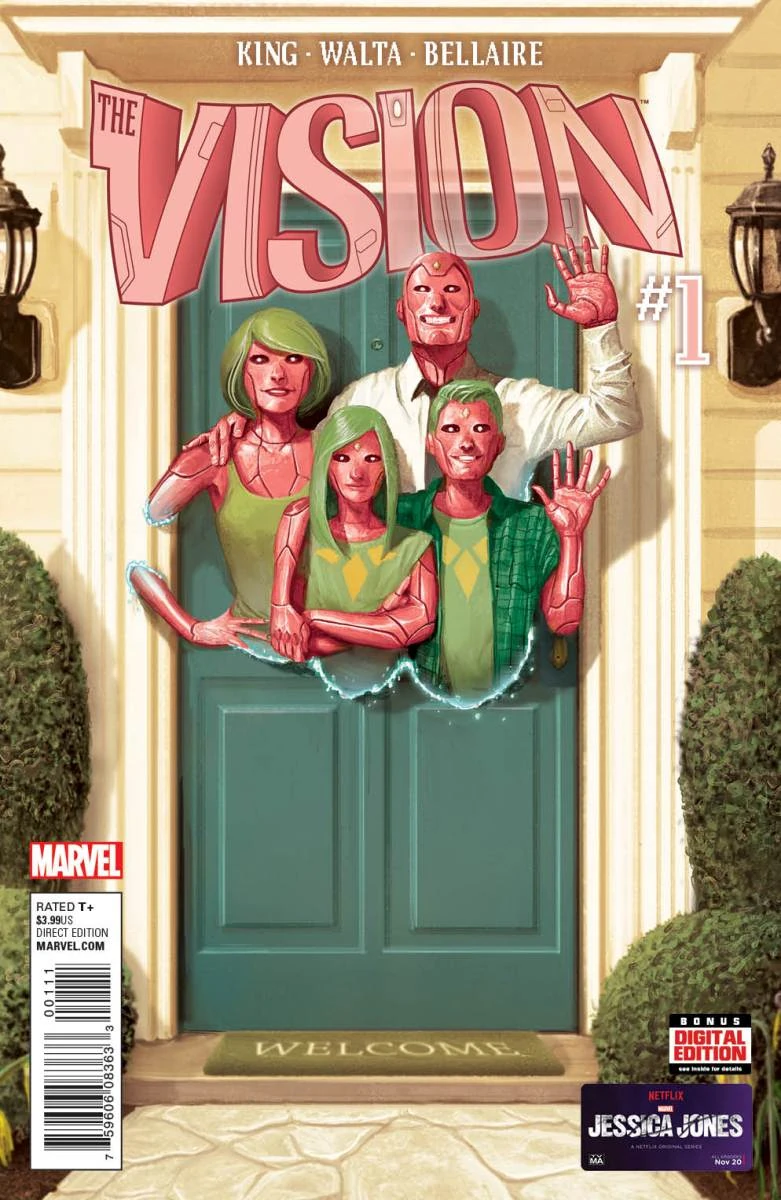
The Vision is a good example of what comic books can aspire to. Or I should say graphic novels. The phrase "graphic novel" is frequently used to mean 'any sort of comic book that's longer than a single issue,' but I think that there is a distinction between a comic book and a graphic novel.
A long time ago (just over four years) I wrote a lengthy and very boring post about why people bother putting the words "a novel" on their books. I wondered so much that I spent some time looking it up, and learned that "novels" originally were books that (as the name suggests) were new kinds of stories: stories that focused more on character than plot, with a 'plausible' storyline.
That description now more aptly applies to what would loosely be termed "literary fiction," although even that category is getting too broad; when I went to look for new books on sale on Amazon the other day, I first clicked on "Scifi/fantasy," and got about 12 books. I then clicked "literary" and got about 2500 books, and the 12 books that had been in "scifi" were also in there. Some of them were Kurt Vonnegut books, which I would agree is a very literary form of scifi, but I think you ought to pick a genre and stick with it. If everything is literary fiction, nothing is.
So not every 'comic book' is a graphic novel, but The Vision is a graphic novel as I think of novels: novels are still to me books that are more concerned with a character's personal arc than plot. In a thriller, say, a character may learn something or grow a little, but in the end you're reading it to find out who the serial killer is or whatever. In a novel, you're reading it to see how the person the story is about develops.
The Vision is all about the latter; it begins with a weird unexplained thing about how The Vision wiped his memories of emotions, or something, and moved to suburban Washington DC with a family he had created: a wife, Virginia, and twins Viv and Vin, who are teenage synthezoids created in part from the Vision's and his wife's brainwaves and so must go to school to mature their minds.
From there, the plot proceeds almost along Fargo-esque lines: Behind the scenes of this regular life there are serious fatal goings-on. The Vision worries about money (for some reason he's not being paid by The Avengers even though he still fights with them and advises the President about Avengerish things. This is a plot point that seems thrown in for the specific reason of getting his wife out of the house at one point, as it is otherwise mostly ignored so far), and wants his family life to be perfect or as perfect as possible. Neighbors, meanwhile, behave in more or less rote fashion -- some like the Visions, some want them gone, some fear them, etc.
So far this would all be a run-of-the-mill Spider-Man or X-Men comic, but those are just plot mechanics that help keep things moving. What's going on is informed more by the fact that the Visions are not human, quite, and are also fairly new at even existing, and also that they were created by Ultron, who is after all an evil robot that intended The Vision to be used to destroy the world. That's a heavy load of problems to carry for anyone, and it helps determine how the Visions react to the events that unfold.
(Imagine, if you can, not only knowing your creator for sure but knowing that your creator was evil and intended to use you for evil. I think even the Catholics would have to concede that would be a bit much guilty baggage to unload on someone.)
The idea of being nonhuman, or alien, often is sugarcoated or ignored or painted in stark contrasts in the comic world. One reason I've enjoyed the new take on Superman in The Man Of Steel (which took some coming around to on my part) and Batman vs. Superman is that in fact it makes Superman a real alien; he looks human but he's not, and he doesn't always incorporate our own thinking into his alien morality all that well, either. That's a more subtle thing than the X-Men's we're mutants so they hate us so we hate them version of nonhumanity, and something like that is at work in The Vision.
The Vision is a human of sorts: he is organic, but was created rather than born, and is therefore something weirder and more scifi even than a 'test-tube baby' (I can remember when there was an uproar over test-tube babies? Scientists estimate that 5,000,000+ babies have been born via "in vitro" fertilization methods, with the first-ever being born in 1978.) Test-tube babies, though, can't be picked out by sight, while a 'synthezoid' can, what with being red-skinned and having glowing eyes and all. Since humans primarily discriminate on the basis of what we can see, and then on the basis of what we fear, looking different often translates into problems. Looking different and being different at the same time is trouble, doubled.
The Vision's plan is to more or less mimic human activity in hopes of making himself more human: they decorate their house and have guests over and wear clothing and the like because doing so will make them act more human. This all falls apart when early on in their attempt, a bad guy attacks the house while The Vision is out. (There's a backstory there that I suppose regular Avenger readers know but I won't get into it as it doesn't matter much.) Virginia defends the family by killing the bad guy and burying him in the backyard, then lies to The Vision about this. Viv, the daughter, is injured in the attack and Vision must try to save her at Avengers HQ while, predictably, Virginia's decision to kill and lie has bad consequences that anyone who has watched Fargo (the series) or read or seen similar stories can predict: someone saw her, she confronts that someone, there is lying to the police, etc.
What raises The Vision above those stories is more than the mashup of crime drama with superhero story; it's that the story isn't just 'people in over their heads' but 'people (?) trying to fit in and getting over their heads.' Near the end of the first volume a subplot involving someone predicting the future winds up, and the problem with The Vision's plans becomes clear: if he continues on the path he's chosen, he is going to have to try to destroy The Avengers themselves.

The Vision isn't evil; this is one of those stories where each step seems reasonable enough until the ultimate effect of those steps is to be unreasonable (a type of story I enjoy immensely anyway) but it's layered with meaning here: The Vision isn't just trying to hold onto a life he's carved out; he's trying to carve out a life in the first place, so he is violating all these rules in hopes of achieving something that may not even be worth what he thinks it is; if it's easy enough for us to imagine going to great, even criminal, lengths to protect our families and middle-class lives, it's harder to imagine doing criminal activity just to get there, while we go through the motions of pretending we have it in the first place.
I haven't finished the entire series yet -- it's three volumes -- but already the first volume is one of my favorite things I read this year (and it's a quick read). What sets the story apart, too, is that the pictures inform the story: they are more than the typical comic book panels: they're moody and artsy and serve almost as movie sets. Many times when I'm reading comics or graphic novels the pictures are a distraction or don't add to the story, and the medium makes the story awkward: characters having to declaim their motivations, for example (or in some cases describing what's in the picture even though there's a picture) but that's not the case here; the artwork adds to the story and makes it more engrossing. I can't wait for the next two to arrive at the library.
