Last night I bought "Act 1- New Game" by Phillip Leon (son of writer extraordinaire* Andrew Leon). Andrew says it's good music to write to, and it is that -- it's got soundtrack written all over it -- but it's also just plain good music to do anything to. You could listen to this music and go for a walk, or listen to this music and rail against rich people, or listen to this music and kneel for the National Anthem, or listen to this music and dream of the day when society finally stops letting rich f***s destroy the world and we can all be a little happier.
You can listen to the music and be a little happier, and for just $5** you can get the music for yourself and make Phillip Leon both a little happier, and a lot more likely to keep on making cool music like this. Go buy your own copy here.
*WHEN IS BROTHERS KEEPER COMING OUT ANDREW FOR CRYING OUT LOUD!!!
**Come on it's FIVE BUCKS. Even I spent that much and I am the cheapest living human being.***
*** that's true. I won't buy a brown belt to wear with my brown pants because what am I the queen of England here?
Showing posts with label thinking the lions. Show all posts
Showing posts with label thinking the lions. Show all posts
Friday, October 20, 2017

Thursday, October 19, 2017
Shut up about celebrities giving away a miniscule amount of their net worth.

Chris Long Will Donate All His 2017 Game Checks To Charitable Causes
It's all over the headlines, at least the headlines that deal with athletes. Chris Long is apparently an NFL player on the Eagles. He will make $1,000,000 this year and has already given away six of his paychecks (of six games) with 10 to go. Says Deadspin:
Long will donate the money to “organizations supporting educational equity and opportunity” based in the three cities he’s played in: St. Louis, Boston, and Philadelphia. He used his first six game checks to fund scholarships in Charlottesville, Va., which means he will use his whole 2017 salary to educate others. Long is in the first year of a two-year, $4.5 million deal with the Eagles, and his base pay for the year is $1 million.
“I’m playing the entire 2017 NFL season without collecting income because I believe that education is the best gateway to a better tomorrow for EVERYONE in America,” Long said on his website.
Apropos of what I said yesterday, though, Long has actually earned $88,000,000 in his career. He is giving away 1/88th of his total past earnings. He's about 30 years old. So if Chris Long lives to be 100, he will live another 70 years. If he never earns another penny again, he will have an average of $1,257,000 to spend each year for the next 70 years of his life.
His average earnings per year so far have been $9,798.000. Because of the way search engines work it is impossible to find out how much he might have donated in the past, so I can't comment on that.
People frequently justify paying millions of dollars to athletes by pointing out that they work very hard to do what they do, have short careers, and not everyone can do what they do. That is true of numerous other occupations, including lawyer and doctor and tax accountant and teacher. And while athletes careers are short, the fact that many of them make tens and hundreds of millions in a few years is not justified by a short career; most people do not make tens of millions in their lifetime.
Plus, Chris Long is the son of NFL and television star Howie Long, which means Chris had advantages growing up that many kids who aspire to be in the NFL do not have. He went to a private school where tuition starts, for pre-kindergarten, at $13,000+ per year, for example. He went to the University of Virginia as an undergraduate before going to the NFL as a 2nd overall draft pick. Going back to 1942, only 168 UVa players have ever played in the NFL. Is it possible that being the son of a former NFL player who had a television position at the time his son was playing helped attract the attention of NFL scouts to a college that places about 2 players per year on average into the NFL (out of 1,600 players total on active rosters at the start of the season?)
Deadspin, which is usually pretty good about pointing out hypocrisy in sports, played up the Chris Long story without batting an eye. But Chris Long's donation means very little in the life of Chris Long, who likely will have a long and fruitful career post-NFL as well, as a television personality or coach, and who already has earned more money than 10 other men will in their lifetime. Chris Long's million-dollar donation also means very little in the life of those who depend on donations for education.
In 2012, the Washington Post published an article on how grossly underfunded public schools are. In 2017 Complex published essentially the same story, updated. America spends less than $10,000 per year, on average, per public school child. Attending an NFL game costs a fan, on average, $209 per game. With 8 home games per year, an average NFL fan spends in excess of $1,600 just watching football. The Philadelphia Eagles average 69,000 fans per game; each home game you see Chris Long play in means that people voluntarily spent $14,421,000 that day alone to attend that game. If the Philadelphia Eagles (a company valued at $2,650,000,000 -- that's two billion) donated one game worth of attendance per year, they could increase public school spending by $14,00,000 per year. If each of the 32 NFL teams did that, it would amount to $461,472,000 worth of extra school spending.
The Philadelphia Eagles' owner, Jeff Lurie, is worth $2,000,000,000. If he would give up 1% of his money the way Chris Long gave up 1% of his, an extra $200,000,000 would be given to education.
So Chris Long's self-aggrandizing donation costs him little and does very little for public education in this country. And Chris Long's dedication to public education is questionable in the first place; not only did he go to private school, but he endorsed Gary Johnson in the 2016 election. Gary Johnson wanted to get rid of the Department of Education and wanted to privatize public education in New Mexico using the voucher system. Sound familiar? It's essentially the Trump/Scott Walker plan to dismantle public education.
In the end, Chris Long gets a ton of publicity to top off the Super Bowl ring he lucked into last year, all in exchange for making a 'sacrifice' that isn't. Chris Long is a phony and people who give him attention for this are playing into the myth that celebrities are worth celebrating.
Wednesday, October 18, 2017
Technically his character in "Firefly" had been fighting on the wrong side in that war, too.
 Celebrities make millions of dollars, and lord it over regular people like us. While we (and I in particular) frequently rail against the billionaires who now run the country officially and previously and soon will run it unofficially when they return to their day jobs, it's important to remember that 'celebrities,' about whom there is little to celebrate, as they contribute nothing to life in any meaningful way, also have millions upon millions of dollars which they use selfishly.
And do not tell me that "celebrities" donate millions of dollars; a famous person who has $100,000,000 and donates $1,000,000 of that has donated 1% of his or her wealth, which is a miniscule amount, especially considering that the person would be left with $99,000,000, which is more money than any one person can spend in a lifetime and more than any one person should be allowed to have. If you make $100,000 per year and donate $1,000 of your money to charity, you've made the same percentage donation, but have hurt yourself worse than the celeb who donates 1%, because you are left with only $99,000 and must go on working and earning money to continue to live; a 'celebrity' who is left with "only" $99,000,000 need never lift a finger again, literally.
"Celebrities" make it worse when they use their star power to demand money from us not just for entertainment, but for charity, rather than simply contributing their own money and shutting up about it. If you call in to a charity and donate $100 because Seth Myers asked you to, do you get a raise at work and more attention from your boss? Likely not. But because the 'celebrity' was on TV, people will buy their album or watch their movie or whatever. So shut up about celebrity charity work, too.
This whole rant was set off by Captain Hammer's self-satisfied smug Instagram post there. I saw that just before I left for work this morning, and it enraged me. I love to travel. I love it. It is one of my favorite things to do. I don't get much of a chance to travel, though, as I had to point out to Captain Hammer in my responses:


I'd post more, but it's 8:20 a.m. and I have on my agenda today an appeal in a foreclosure case and then working to keep a client from being evicted from her house. After that I will probably work a bit on helping people whose cars were repossessed or whose kids were bullied at school, until I go home tonight to see if Mr F will sleep through the night at all, as he's not sleeping again -- hasn't slept well 6 of the last 7 days and slept only about 2 hours last night -- and we don't know why.
But yeah after that I'll probably contact my travel agent and use some of the millions of bucks I earned pretending to be a space captain so that I can go jet around the world and crap all over people who work for a living.
Sunday, October 15, 2017


Friday, August 18, 2017
Study hard and go to school every day

Study hard

and go to school every day

And someday you

Will get to watch as some OTHER guy gets to have a job involving knocking down a house while you head into your office.
Thursday, December 29, 2016
I know statistically speaking fewer people will probably see it here than in the comments of the original video but I needed to vent just a little more.
Maybe I was just tired after spending the night before down at the ER dealing with a blood clot in my leg, but last week I watched a video about why we are "so nostalgic" and was offended by the simplistic way it attacked the question, from its lack of defining the question or the basic terms to the junk-science way it then tackled the self-fulfilling prophecy of its so-called thesis.
Here is the video, which originally I saw on Sploid but which is from something called "8 Bit Philosophy," which itself seems to exploit some nostalgia, both of which I would avoid in the future. Following it is the comment I quickly dashed off in my anger.
My comment:
Here is the video, which originally I saw on Sploid but which is from something called "8 Bit Philosophy," which itself seems to exploit some nostalgia, both of which I would avoid in the future. Following it is the comment I quickly dashed off in my anger.
My comment:
Awesome! Cereal-box psychology! It makes sense as long as you don’t think about it.
If “nostalgia” doesn’t change, then changing the past to adapt our views of the new world — adapting Star Trek to terrorism — isn’t consistent with the definition of “nostalgia” they give. There was no talk of the Industrial Revolution-era workers ‘adapting’ King Arthur to address their more modern fears.
Also, it seems like ‘nostalgia’ is a pretty broad idea, if Mussolini’s nostalgia for fascism and modern people’s nostalgia for Full House are the same concept.
The ‘nostalgia’ feeling people get has a lot more to do with branding than with nostalgia or fear of an information revolution. The ‘revolution’ people are talking about is 17 years old, at least, and the things people are ‘nostalgic’ for include movies that are only 20 years old. A far cry from the nostalgia for the Roman Empire, which wasn’t so much nostalgia as it was adoption of a rallying cry and motif, the way our soldiers might put sharks on planes; it’s not that they’re secret icthyologists.
It’s just plain easier to sell a rando space opera as “Star Wars” branded (http://thinkingthelions.blogspot.com/2016/01/book-six-star-wars-inc.html) than it is to create a whole new market: the old business adage that selling more to existing customers is easier than finding new customers applies no less to pop culture than to potato chips or cars (if “nostalgia” is so big why are there no retro cars?).
Moreover, where are the facts that we are any MORE nostalgic these days than in say the 1970s when Lucas was creating “American Graffiti” or the 1980s when they were making Indiana Jones movies — updating the old “serials” — and remaking ‘Clash of the Titans’ using old fashioned techniques.
I guess if you loosely define a word enough, and then don’t care about the comparisons you make, you can make ANYTHING sound smart. Watching this was a waste of 4 minutes (I stopped early.)
Saturday, December 24, 2016

Tuesday, December 06, 2016
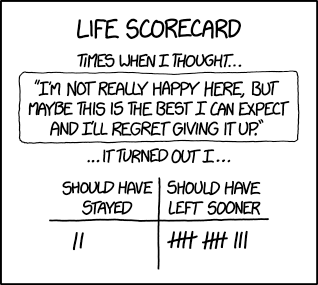
Friday, September 23, 2016

Saturday, September 17, 2016
So this really isn't worth reading at all.
 |
| Mr F is very different to, than, and from, many other kids. |
I read an article with some spoilers about the Justice League movie and The Force Awakens, and came across this:
Here’s a quote from Adam Driver discussing the film’s tonal shift—saying that, just as Empire Strikes Back was different to A New Hope, Episode VIII is different to The Force Awakens:
I found it kind of jarring, because I had just read a different article about a scene from Iron Man 3 (look I told you it was light reading, I was in between complicated legal battles and wanted my brain to cool off a bit), and in that Iron Man article an actress had said:
I signed on to do something that was a substantial role. She wasn’t entirely the villain – there have been several phases of this – but I signed on to do something very different to what I ended up doing.
The thing that made me pause about both of those was:
"different to."
Different to.
I've always said different than.
I'm not some kind of Grammar Monster -- that's more Andrew Leon's bag, although I'm sure he would see it as "Grammar Crusader" -- but when something starts showing up all over the place and I haven't heard about it, I feel like I missed the boat somehow, like everyone got together one day and said hey let's all say different to and make Briane feel like a nerd, which is 100% how I assume the world operates.
So I looked it up and found out I'm either wrong anyway or maybe a bit right, so far as 'proper' grammar goes. This site says that traditionally it was different from, but that different to is gaining acceptance. "Different than," it says, can be used but is usually used with clauses rather than single words -- which means that of those quotes, the Star Wars guy probably had it right (the movies being a proper noun and so hence a singular kind of thing) while Iron Man Lady got it wrong, because hers followed a clause.
Unless of course I'm totally wrong and here is the part I hate about grammar and also love, because you are always wrong or always right (and truthfully, I think grammar matters only insofar as you are making yourself understood, but I also think that you ought to know the basis precepts of grammar and make conscious choices to ignore them, like Ezra Pound might have done). Anyway, this site says that the to and than forms are the ones that are correct:
First, one point in favor of different to and different than is that these constructions are common and have been common for centuries. They have appeared in works of great writers and can be found in books from editorially fastidious publishers, and no English speaker has trouble understanding them. Different than, which is especially common in the U.S., appears about twice for every three instances of different from in 21st-century newswriting from the U.S. and is common (though less so) in American books from this century. Different to, meanwhile, is nearly as common as different from in recent U.K. newswriting and is easily found in U.K. writing of all kinds not just from this century but from as long ago as the 18th century.
So those are "facts", quotes needed because there is no source for those facts listed and when you say stuff like "editorially fastidious" and "about" you are saying "these are judgment calls, opinions, and guesses" -- what constitutes an editorally fastidious person? Where's the cutoff?-- and the article goes on to suggest that despite than and to being common and making sense for other reasons, you shouldn't use them...
... so I went to the Oxford English Dictionary, which has the distinction of having been more or less originally written by a madman, for the definitive answer, but my computer wouldn't log on. So there you have it.
Tuesday, August 23, 2016
If he can make 12 years' worth of Rex Morgan MD jokes funny, he can probably write a pretty good novel.

He wrote a very informative and interesting article about how much he made and how he did it. If you're a would-be or struggling writer, it's worth reading. Check it out here.
Friday, August 05, 2016
OK this guy deserves the Nobel Prize for real.
I was skeptical of the article on Jalopnik entitled "I have invented the ultimate food to eat while driving" but I read it because I frequently eat while driving. From last night, where we had to make an emergency trip to the pool for Mr F, who was inconsolable and asking for it so clearly that we decided it was worth it for me to take him instead of sitting down to eat dinner, to the times I'm on the road for up to 8 hours a day and don't want to sit at a restaurant to eat a meal, I have a need of foods that can be eaten one handed, especially while wearing a shirt and tie. (I don't wear my coat in the car. This isn't Victorian England.)
But the guy really did it. Here's the concept art:
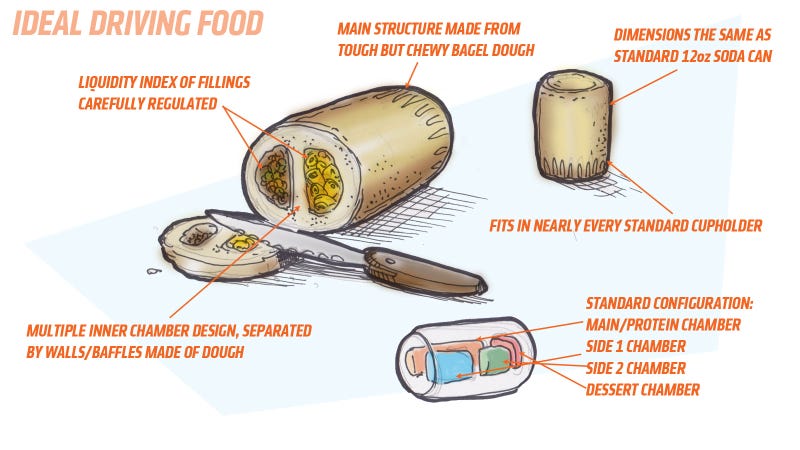
I would 100% exist on that if I could. The whole article is worth reading, not just because of the idea, but because of how he worked out why this would be so perfect. I want one with sausage on one side and eggs and cheese on the other for breakfast, and a pizza one for lunch, with the side being cheesy garlic bread. I can't stop thinking about the varieties. Also now I'm hungry.
But the guy really did it. Here's the concept art:
I would 100% exist on that if I could. The whole article is worth reading, not just because of the idea, but because of how he worked out why this would be so perfect. I want one with sausage on one side and eggs and cheese on the other for breakfast, and a pizza one for lunch, with the side being cheesy garlic bread. I can't stop thinking about the varieties. Also now I'm hungry.
Wednesday, June 29, 2016
The Sorta Great Wall
This is a repost from June, 2008.
 Here's why I'm increasingly down on science: I've heard over and over that most of what we think of as "matter," which laypeople call "stuff," is actually made up of empty space.
Well, that's a lot of, as my dad used to say, "bull-lar."
I don't know what "bull-lar" was, but my dad said that a lot of things were "bull-lar." He'd say what we did, as kids, was "bull-lar." He'd be yelling at us for something, and say something parental, old-school parental, like "You think you can just take a car and race it along and jump it 100 feet off the road? Well you can't! That's a lot of bull-lar!" (It was not 100 feet, though. It was 110, at least.)
Between the frequent use of the phrase "bull-lar" and my dad's habit of holding my younger sister, who was only about two, while he yelled at us, very little 'punishment' actually soaked in because we spent half the time wondering what "bull-lar" was and half the time watching our sister mimic dad as he yelled.
I suppose "bull-lar" was one of those things that parents learn to say when their kids are young because they don't want to swear around their kids and are trying to be good role models. I try to do that, too, which was why a while back when I slipped while installing the stove hood and banged my head hard enough to draw blood, I didn't swear or cuss or yell. I didn't do anything for about 10 minutes except try not to explode, and I did it. I didn't swear at all. I just bled. So I'm a good role model, except that while I try not to swear and I never drink, I also regularly let the Babies! watch, on Youtube while they eat breakfast, a clip of Butters from "South Park" singing What What In The Butt, which I think is hilarious and the Babies think is hilarious, too, and it really helps us get through breakfast a lot easier.
I know, I know. I can hear you now: How can you possibly do that? How can you, of all people, possibly expose your not-even-two-year-old boys to copyright infringement? I feel bad about, it, too. But listen to my side: A family is an economic partnership. Everyone has to pitch in. So some people make sure that the Babies! get fed and some people make sure the Babies! get bathed and some people make sure that the Babies! don't fall out of windows. Those people, in our family, are Sweetie. Other people (me) have them watch South Park clips on Youtube and determine what occupations they will have in the future to make sure they make enough money that Other People (me) don't have to work after they're fifty. (Currently, Plan A is them having a Disney show, since if you are a kid and you appear on Disney TV you are instantly worth a billion dollars, and also, I like "Bunnytown.")
Plus, consider this: if someone in the family is going to take a fall for the rest of us, shouldn't it be the infants? Let's face it; someone has to pirate the South Park clips and illegally download music and make fun of Tom Cruise. If, when the hammer comes down, the Babies! take the fall, then they will receive shorter jail terms and lighter sentences because, well, they're cute. Cuteness is still a defense to most criminal charges, isn't it? I should probably know that.
But I don't know that. I don't know a lot of things because all my memory is taken up with everything "science" has filled my head with, like hokey stories about how everything is mostly empty space, how we are all made of "atoms" and that these are very small and are made up of mostly smaller things like "electrons" and "quarks" and "my paycheck" and that as a result of all this small-osity, things that we think of as solid matter, things that seem good and thick to us -- the table, the old shed, Kris Kristofferson-- are in fact mostly empty space.
Well, I'm not buying it. I'm not buying it because nothing is mostly empty space.
I'm not mostly empty space. I've tried, unsuccessfully, fitting into some of my more favorite t-shirts lately, and I've tried going jogging, and I can assure you that I am far from being made up of mostly empty space. Empty space would have a far far easier time lugging it's empty-space-belly up the hill at the end of empty space's running route, and empty space would not fill up a t-shirt quite so snugly. My own scientific analysis has led me to conclude, at this point, that I am mostly made up of Peanut Butter Cap'n Crunch, which also is not mostly empty space.
Another thing that is not at all empty space was our old shed, which is finally down, and which somehow warped time and space in that the shed, torn down, managed to contain more actual material than it had when it was still standing. I can remember when it was standing, and it was four walls and a roof and some old household furniture inside. I would go inside, sort of. I would actually stand just outside the shed and look in, to see if there was a place to put more junk, in between the older junk and the raccoons, and the shed was full of lots of seemingly empty space, because it wasn't full of stuff and according to "science," things that aren't full of stuff are mostly empty space. I wish "science" had been here to help with the work. But, as usual, "science" never shows up until the work's done and the pizza's being served, when "science" tries to prove that it knows something after all by having your pizza remain superhot for longer than it should so that you burn your mouth even though you waited a really, really long time before eating the pizza.

Tearing down the shed was like battling the hydra; every board we tore out created three more. Every wall that came down left two more. It just kept multiplying and multiplying and we just kept hauling it to the second of two dumpsters using our specialized shed-tearing-down-tools of "old winter gloves" and "a garbage can with wheels."
Using that highly technical equipment, we threw away the entire shed which, when torn down created a pile of rubble that took up two dumpsters. Two. When they redid our roof last year, they only used one. So there was more stuff in that shed than there was in our entire roof on our house.
Of course, the roof of our house did not contain, as I found out the shed did, five live raccoons and one very very dead raccoon. At least I hope it didn't, because if there is that much wildlife in our roof, I'm moving.
 Here's why I'm increasingly down on science: I've heard over and over that most of what we think of as "matter," which laypeople call "stuff," is actually made up of empty space.
Well, that's a lot of, as my dad used to say, "bull-lar."
I don't know what "bull-lar" was, but my dad said that a lot of things were "bull-lar." He'd say what we did, as kids, was "bull-lar." He'd be yelling at us for something, and say something parental, old-school parental, like "You think you can just take a car and race it along and jump it 100 feet off the road? Well you can't! That's a lot of bull-lar!" (It was not 100 feet, though. It was 110, at least.)
Between the frequent use of the phrase "bull-lar" and my dad's habit of holding my younger sister, who was only about two, while he yelled at us, very little 'punishment' actually soaked in because we spent half the time wondering what "bull-lar" was and half the time watching our sister mimic dad as he yelled.
I suppose "bull-lar" was one of those things that parents learn to say when their kids are young because they don't want to swear around their kids and are trying to be good role models. I try to do that, too, which was why a while back when I slipped while installing the stove hood and banged my head hard enough to draw blood, I didn't swear or cuss or yell. I didn't do anything for about 10 minutes except try not to explode, and I did it. I didn't swear at all. I just bled. So I'm a good role model, except that while I try not to swear and I never drink, I also regularly let the Babies! watch, on Youtube while they eat breakfast, a clip of Butters from "South Park" singing What What In The Butt, which I think is hilarious and the Babies think is hilarious, too, and it really helps us get through breakfast a lot easier.
I know, I know. I can hear you now: How can you possibly do that? How can you, of all people, possibly expose your not-even-two-year-old boys to copyright infringement? I feel bad about, it, too. But listen to my side: A family is an economic partnership. Everyone has to pitch in. So some people make sure that the Babies! get fed and some people make sure the Babies! get bathed and some people make sure that the Babies! don't fall out of windows. Those people, in our family, are Sweetie. Other people (me) have them watch South Park clips on Youtube and determine what occupations they will have in the future to make sure they make enough money that Other People (me) don't have to work after they're fifty. (Currently, Plan A is them having a Disney show, since if you are a kid and you appear on Disney TV you are instantly worth a billion dollars, and also, I like "Bunnytown.")
Plus, consider this: if someone in the family is going to take a fall for the rest of us, shouldn't it be the infants? Let's face it; someone has to pirate the South Park clips and illegally download music and make fun of Tom Cruise. If, when the hammer comes down, the Babies! take the fall, then they will receive shorter jail terms and lighter sentences because, well, they're cute. Cuteness is still a defense to most criminal charges, isn't it? I should probably know that.
But I don't know that. I don't know a lot of things because all my memory is taken up with everything "science" has filled my head with, like hokey stories about how everything is mostly empty space, how we are all made of "atoms" and that these are very small and are made up of mostly smaller things like "electrons" and "quarks" and "my paycheck" and that as a result of all this small-osity, things that we think of as solid matter, things that seem good and thick to us -- the table, the old shed, Kris Kristofferson-- are in fact mostly empty space.
Well, I'm not buying it. I'm not buying it because nothing is mostly empty space.
I'm not mostly empty space. I've tried, unsuccessfully, fitting into some of my more favorite t-shirts lately, and I've tried going jogging, and I can assure you that I am far from being made up of mostly empty space. Empty space would have a far far easier time lugging it's empty-space-belly up the hill at the end of empty space's running route, and empty space would not fill up a t-shirt quite so snugly. My own scientific analysis has led me to conclude, at this point, that I am mostly made up of Peanut Butter Cap'n Crunch, which also is not mostly empty space.
Another thing that is not at all empty space was our old shed, which is finally down, and which somehow warped time and space in that the shed, torn down, managed to contain more actual material than it had when it was still standing. I can remember when it was standing, and it was four walls and a roof and some old household furniture inside. I would go inside, sort of. I would actually stand just outside the shed and look in, to see if there was a place to put more junk, in between the older junk and the raccoons, and the shed was full of lots of seemingly empty space, because it wasn't full of stuff and according to "science," things that aren't full of stuff are mostly empty space. I wish "science" had been here to help with the work. But, as usual, "science" never shows up until the work's done and the pizza's being served, when "science" tries to prove that it knows something after all by having your pizza remain superhot for longer than it should so that you burn your mouth even though you waited a really, really long time before eating the pizza.

Tearing down the shed was like battling the hydra; every board we tore out created three more. Every wall that came down left two more. It just kept multiplying and multiplying and we just kept hauling it to the second of two dumpsters using our specialized shed-tearing-down-tools of "old winter gloves" and "a garbage can with wheels."
Using that highly technical equipment, we threw away the entire shed which, when torn down created a pile of rubble that took up two dumpsters. Two. When they redid our roof last year, they only used one. So there was more stuff in that shed than there was in our entire roof on our house.
Of course, the roof of our house did not contain, as I found out the shed did, five live raccoons and one very very dead raccoon. At least I hope it didn't, because if there is that much wildlife in our roof, I'm moving.
There is nothing quite like pulling up an old board and seeing most of a raccoon skull sitting there in front of you, not quite attached to most of a raccoon skeleton. The only thing I could think was where's the rest of it? Is it on me? I still kind of feel that way. That's my most common reaction to nature, as I sit here and think of it: Is it on me? I'm not the outdoorsy type. Put me outdoors for any length of time, and I'll begin to think that the outdoors is on me, and not shake that feeling or the way it makes my skin crawl, until I get back inside, take a shower, and watch Newhart on DVD.
But it's done! The shed is down, and where there used to be a sagging, possibly haunted shed there now stands what looks like empty space but isn't. What it is, is a bare dirt area covered with leaves and bits of grass and the smaller debris that I decided to leave there. Trust me, it's an improvement, even if technically part of that dirt area is still made up of shed parts.
There's still shed parts there because I took The Boy's advice, something I only am ready to do when I've been working in the hot sun all day and am covered with raccoon flakes. We were hauling and hauling and I was trying not to think of what the pieces of animal would do to my lungs and, and we got down to the last two items of stuff to haul: the world's largest collection of cement cinder blocks, and a pile of stuff that included shingles but was, in my imagination, made up mostly of dead animal skin, animal skin that was getting on me.
We looked at that, me and The Boy and The Boy's Friend, who I'll call "Q," and The Boy said the smartest thing he's ever said. He said "Let's just let erosion do its thing." Who says kids don't learn anything these days?
I brushed some raccoon parts off my head and decided we'd do just that. We spread the pile back out and hoped for erosion to work more quickly than most so-called "science."
That left the cement bricks, which as it turned out made up a lot of what appeared to be the empty space under the shed. (They may also make up a lot of the empty space in me, if the doctor's scale is to be believed.) There were more cement bricks under that shed than I could have imagined. If cement bricks were money, we'd be rich. But they're not, so we're just tired.
We decided to not haul the cement bricks, and instead to turn them into The Sorta Great Wall. I began stacking them into a line of bricks along the lot line between our house and Q's house next door. I got permission to do this by asking Q "Do you think your parents would want us to stack those bricks there?" He shrugged and said he'd ask them, and then I began stacking them there before he could do that, because people can only tell you "no" if you give them a chance.
The Sorta Great Wall now extends about fifteen feet along the lot line, and about two feet tall, and will hopefully one day be very scenic. Until then, I'm hoping that Robert Frost was a little wrong. "Good fences," Robert Frost probably said, "make good neighbors." I'm hoping that "Crummy fences made up of things you are too lazy to haul to the dumpster" make good neighbors, too. Or least make neighbors not call the zoning committee on you.

That's what I've spent the first three days of my vacation doing: Tearing apart the last of the shed, beginning construction of The Great Wall, and pondering just why science is never right. Because I know now: matter is not made up of 'empty space.' It's made up of cement blocks and raccoon skins, and it's on me.
But it's done! The shed is down, and where there used to be a sagging, possibly haunted shed there now stands what looks like empty space but isn't. What it is, is a bare dirt area covered with leaves and bits of grass and the smaller debris that I decided to leave there. Trust me, it's an improvement, even if technically part of that dirt area is still made up of shed parts.
There's still shed parts there because I took The Boy's advice, something I only am ready to do when I've been working in the hot sun all day and am covered with raccoon flakes. We were hauling and hauling and I was trying not to think of what the pieces of animal would do to my lungs and, and we got down to the last two items of stuff to haul: the world's largest collection of cement cinder blocks, and a pile of stuff that included shingles but was, in my imagination, made up mostly of dead animal skin, animal skin that was getting on me.

We looked at that, me and The Boy and The Boy's Friend, who I'll call "Q," and The Boy said the smartest thing he's ever said. He said "Let's just let erosion do its thing." Who says kids don't learn anything these days?
I brushed some raccoon parts off my head and decided we'd do just that. We spread the pile back out and hoped for erosion to work more quickly than most so-called "science."
That left the cement bricks, which as it turned out made up a lot of what appeared to be the empty space under the shed. (They may also make up a lot of the empty space in me, if the doctor's scale is to be believed.) There were more cement bricks under that shed than I could have imagined. If cement bricks were money, we'd be rich. But they're not, so we're just tired.
We decided to not haul the cement bricks, and instead to turn them into The Sorta Great Wall. I began stacking them into a line of bricks along the lot line between our house and Q's house next door. I got permission to do this by asking Q "Do you think your parents would want us to stack those bricks there?" He shrugged and said he'd ask them, and then I began stacking them there before he could do that, because people can only tell you "no" if you give them a chance.
The Sorta Great Wall now extends about fifteen feet along the lot line, and about two feet tall, and will hopefully one day be very scenic. Until then, I'm hoping that Robert Frost was a little wrong. "Good fences," Robert Frost probably said, "make good neighbors." I'm hoping that "Crummy fences made up of things you are too lazy to haul to the dumpster" make good neighbors, too. Or least make neighbors not call the zoning committee on you.

That's what I've spent the first three days of my vacation doing: Tearing apart the last of the shed, beginning construction of The Great Wall, and pondering just why science is never right. Because I know now: matter is not made up of 'empty space.' It's made up of cement blocks and raccoon skins, and it's on me.
Saturday, June 25, 2016
I'm starting to think Sweetie doesn't know what marriage is all about.
So I'm sitting here tonight eating my 10:18 p.m. snack and I read on the Internet that MAC N CHEETOS is a thing that exists:

I mention that to Sweetie and she says... and I QUOTE:
"Oh, yeah, I heard about those the other day."
So I have been sitting around the past few days eating food that's not deep-fried macaroni and cheese coated in Cheeto dust while Sweetie has just been sitting on this information like it's no big deal.
I don't 100% remember our wedding vows but the promise to always tell your spouse about new deep-fried cheese-coated foods was at least implied.

I mention that to Sweetie and she says... and I QUOTE:
"Oh, yeah, I heard about those the other day."
So I have been sitting around the past few days eating food that's not deep-fried macaroni and cheese coated in Cheeto dust while Sweetie has just been sitting on this information like it's no big deal.
I don't 100% remember our wedding vows but the promise to always tell your spouse about new deep-fried cheese-coated foods was at least implied.
Saturday, June 18, 2016
"I got into acting for the same reasons I went to Morocco and became a lawyer: I didn't have much else to do."

All the world's a stage and one man in his time plays many parts. Most of my parts involve resting now.
You have to work very hard to irritate people who are doing yoga, but Sweetie and I and The Babies! did just that the other night. Without even trying, and, in my case, without even noticing.
Thursday night was one of my nights to work out this week. I try to work out every third day. That's way down from what I used to do. When I was healthy and young, I worked out every day. It was easier for me to work out every day then because I was healthy and young, and because I really had no other life to speak of. The days when I worked out every day, jogging 5 or 6 or even 16 miles at a crack, were also the days when I was not seeing anyone, when I wasn't working very much, and when the entire furnishings of my apartment consisted of a lamp, a mattress, a couch, a desk, and a tape player/radio. You can only read and/or listen to "Mad Radio 92.1" for so long before you have to go do something, and so I worked out a lot back then, jogging and biking and even rollerblading until I gave that up because rollerblading isn't as much fun once you've scraped off most of the right side of your body in a luxury subdivision.
I was never a great rollerblader, anyway, but I liked it because it gave the feeling of running while not actually being like running. Rollerblading might have been the first of many, many activities that people tried to trick themselves into thinking were actual exercise when they were not. Everything from the "Abdomenizer" to "Tae Bo" has been passed off as being as good as running, when it's not. But in the exercise department, "as good as" can only mean one thing: as much work as. So if you're doing an exercise that is less physically demanding than some other exercise, then it's not as good as that other exercise.
Nothing in the exercise department is as physically demanding as running. Here's what's as good as running, in the exercise department: running.
Although I ran a lot, I didn't like running all the time -- because it was hard-- so I would occasionally mix in rollerblading because it was "as good as" running. It was hard, even then, for me to understand that claim. Rollerblading was nowhere near the amount of work that running was. One of the general rules of life: nothing with wheels on it is as difficult as something without wheels. On the other hand, rollerblading was 17 million times as terrifying as running, again because of the wheels, so maybe those two were supposed to average out to being as hard as running, because the fright would
People always claimed that rollerblades could be stopped. People lied. Rollerblades were and ar
 e unstoppable. I generally dealt with the problem of not being able to stop rollerblades by rollerblading on flat surfaces: the campus of the college I attended, parking lots, the hardwood floors of my apartment, etc. On specific occasions, I dealt with the problem of not being able to stop rollerblades by falling down, not always on purpose.
The fall that led to my quitting rollerblading occurred just a few days before opening night of the play I was in that summer. That was the other thing I did, back then, to kill time: I exercised, and I acted. I got into acting for the same reasons I went to Morocco and became a lawyer: I didn't have much else to do.
"I didn't have much else to do" explains virtually every major accomplishment in my life, as I sit here and look at it. I suppose it's lucky for me that we didn't have cable TV or the Internet when I was a kid or I'd never have gotten out of my parents house (which would be a problem, given that they sold it about 20 years back. But I bet the new people are pretty nice and would have liked me.)
Not having much to do one summer, I decided that I would be an actor and began trying out for parts in local plays. That required me to memorize a Shakespearean monologue, which makes twice in my life that I've had to memorize a Shakespearean monologue. Let's check the stats:
Number of times I have been required by society to memorize a Shakespearean monologue: Two.
Number of times I've been required by society to know how to save someone who's choking or having a heart attack: Zero.
That says something about America. Or me. Or my role in America. I just know it. But I can't say what it says because the only answers I know are found in the various Shakespearean monologues I've memorized.
 Here's another thing I've memorized: the book So Big, starring Elmo. So Big is Mr F's favorite book, because he likes to wave "bye bye" when Elmo does and he likes the [SPOILER ALERT!] fact that Elmo "pops up" and is SO BIG at the end of the book. We read So Big about three times a day; sometimes we read it twice in a row, even though you'd think that it wouldn't hold quite such a thrill once you know the ending. We've read it so often that we're on the second copy of the book; the first got torn apart, understandable what with all the excitement of Baby Elmo standing up and Baby Elmo drinking from a cup.
I can recite So Big by heart. That, too, says something. It says something about the general direction my life has headed since college that I used to memorize Shakespeare and now I can just as easily quote Elmo. ("Baby Elmo sings: la la la.)
Then again, I tend to think that Shakespearean monologues and So Big have roughly equivalent market value for lawyers, so I'm probably doing as well as I ever was. And the Babies! don't get as much of a kick out of my Shakespeare quotes. Maybe they would if Shakespeare popped up at the end. (How big is Shakespeare? SO BIG!)(That might make Shakespeare more palatable to almost everyone.)
I had successfully memorized my quote and turned that into a small part in the play Brother Truckers, which ran for four days at a theater nowhere near anybody. A few days before opening, I went out rollerblading because having landed a part I again had nothing really to do; I only had about four lines in the play. Don't look down on me for that. That one old lady got an Oscar for having, like one line and slapping Denzel Washington, didn't she? Didn't she? I'm going to remember it that way anyway, so there you go: I'm right, and there are no small parts, only small actors.
Except my part actually was a small part and didn't actually require me to even be at all the rehearsals, so I was rollerblading on a beautiful summer day and, feeling daring, had decided to get out on the road a little bit, just a local actor out enjoying the sun, and I started heading through a rich subdivision where no doubt some day I would live after getting my Oscar or whatever award it is they give to small theater productions, and I was cruising down the road and getting faster and faster because it was on a slope, until I reached the critical velocity where I no longer was enjoying the activity but was devoting most of my energy to figuring out how and when I would stop, when that decision was made for me by a patch of hot asphalt, which caught one rollerblade but not the other, sending me skidding along the road on my left side for a long time and scraping off roughly 100% of my skin.
I don't mean "roughly" as in "approximately." I mean it was scraped off roughly.
If you saw that play I was in -- if you were one of the 20 people-- then I apologize if "The Prosecutor" moved a bit stiffly and did all his accusatorial pointing with his right arm. It was not my first interpretation of that character.
Nowadays, I'm even less likely to want to go through that kind of workout. I know all about "no pain no gain," but I can't think of what it is I gained through that fall, and I know I lost a lot, mostly in the skin department. Plus, with my more hectic life now, I don't have all the time and energy and youthfulness and extra skin I need to keep working out like I used to. So now, I try to work out about every third day or so, which makes it easier to fit in my workouts around my busy schedule of not actually ever doing any work in my office and then complaining about how nothing ever gets done.
Another thing that I've found makes it easier to fit in my workout is changing my workout. I haven't changed my basic attitudes towards exercise: running is still the best exercise and I still sneer at people who try to say that something is as good as running. I'll never change that. Once I form an opinion, it's set. I think that most people waste a lot of time and energy changing their opinions all because someone presented a bunch of "facts" and "logical reasons" why they should change their opinions. If my opinion was right once, why wouldn't it be right forever? You don't see other things that are right being changed, do you? Nobody goes around saying that the law of gravity really ought to be re-examined given what we now know about this or that. (Although if they would re-examine the law of gravity, it might help me get back to rollerblading.) So my opinions about running, like my opinions about what constitutes good music and what foods are edible, have stayed constant for decades. (The opinions are, in order: "it's the best exercise," "the song 'Sit Down' by James," and "Doritos.")
What has changed is my opinion about cross-training. Cross-training is where it's at. Nowadays, it's all about cross-training. To stay in shape, I can't just go running all the time, I've decided; I need to mix in some other activities, activities that may not be as good as running but which are valuable because they "work my body in different ways" and "exercise different muscle groups" and do all that other stuff that the doctor says when I've stopped listening because I'm still fixated on the part where he said I need to lose 40 pounds and I'm wondering if I should point out to him that I had my car keys in my pocket when I was weighed and that probably skewed things a bit.
So I've begun cross-training, taking some days off from running, and I've got to tell you, I love it. I love it mainly because of the different activities I can now count as "exercise" and consider myself a healthy person for doing. Here are the activities I mix in as part of my extremely strict cross-training regimen:
Playing basketball one-on-one against The Boy.
Playing "Police Bees."
Yardwork.
Doing some sit-ups while I watch "The Daily Show."
and, most recently,
Taking The Babies! to the health club to play with them for a while because it was raining and I wanted to get out of the house and thought that the club would be pretty empty only it wasn't so we ended up just walking around the track but the boys got antsy and loud so the lady who was teaching a yoga class at that exact time on the area the track went around got on her little yoga-headset and said over the PA that the 'people on the track have to be quiet because we have 10 minutes left' so we gave up and got in the car and went for a drive instead.
That was my workout Thursday night, an integral part of my cross-training regimen. I have to say, I felt great at the end of it. I felt great because it was really a very low-impact workout and also because I hadn't actually heard Yoga Lady yell at us over the PA because to try to quiet down Mr F, I'd taken to swinging him around as I walked to make him laugh, and he was laughing, so I missed the announcement about just how much we were disturbing Yoga Lady; Sweetie had to tell me.
It should be obvious, too, that walking around a track while swinging a 35-pound toddler around is actually a very good workout. You can find out for yourself by buying my new exercise video: Walking Around a Track While Swinging A 35-pound Toddler Around... To The Oldies!.
If you order your copy today, I'll throw in a bonus DVD of me reading So Big! Opening and closing that pop-up at the end is almost as good as running.
Friday, June 10, 2016
Update on Me: 8 years ago I pointed out that the 'experts' are wrong about the Monty Hall problem and 8 years later it's still a thing.
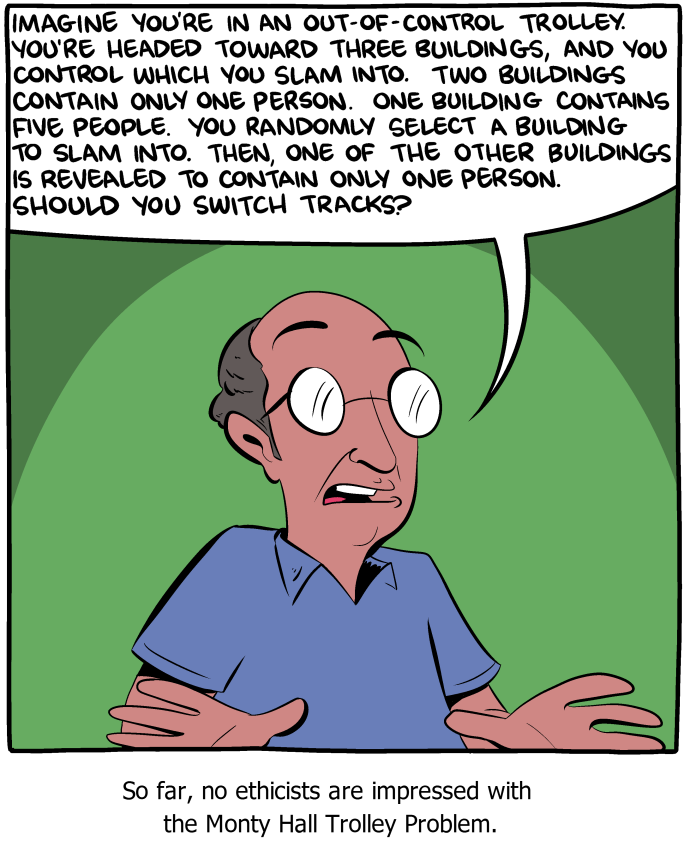
The "Monty Hall" problem is a riddle that is supposed to help demonstrate probability, I think. It first became 'famous' in 1990, when it was featured in a letter to Marilyn Vos Savant, who runs (ran?) a newspaper column.
Here is the way the problem is formulated: You are a contestant on "Let's Make a Deal." In the final round, you have a pick of 3 doors. Behind 1 is a prize. After you pick one, Monty opens 1 of the other 2 doors, and then gives you a choice: stick with your original door, or opt for the other, as yet unchosen and unopened door.
This problem was first formulated in 1975 or so but was based on an earlier problem from 1959.
Most "experts" say that you should definitely definitely switch. They reason that when you first picked a door, you had a 1 in 3 chance of picking correctly, but that after Monty opens a door you have a 1 in 2 chance of picking correctly.
That result has been very controversial, as it goes against what our common sense tells us, and even great thinkers have argued with it (Mathematician Paul Erdos is said to have refused to believe the answer was correct until he saw a computer simulation of it.)
I think the answer is incorrect, and that switching does not improve the chances at all. I believe this because I think that the experts are wrong about your initial odds of being correct.
I wrote about this in a post back in 2008. The problem with the 'experts' analysis is that they assume Monty has changed something in your system.
He hasn't. And the reason he hasn't is a combination of what's known as "Magician's Choice" and the kind of thinking behind is that your final answer from Who Wants To Be A Millionaire?
It was from Robert Lynn Asprin's "Myth" books -- silly (but good) books about a magician named "Skeeve" who has various adventures -- that I learned about "magician's choice." "Magician's choice" is making the onlooker choose something without telling them why they're choosing -- giving them the illusion that they're making a choice and controlling the outcome when they are not at all doing that. Suppose I hold up my hands in fists. In the left is a $10 bill, and in the right is nothing. I tell you that I've got a $10 bill in one hand and say "Choose one." You say "Right," and I say "Okay, that's yours. You get nothing, I keep the $10." Now, suppose instead that you say "Left." All I do is say "Okay, that's the one I keep. The right is yours." You still get nothing, and because I run the game, you were always going to get nothing. I made it look like you were getting a choice but you had no choice. The game is rigged.
That's the first thing that helped me crack "The Monty Hall Problem". The second was "Who Wants To Be A Millionaire," which I used to love before it broke my heart. Remember how, when people played, they'd say "A" and Regis would say "Final answer?" and they'd have to say "Final answer" or they could switch? That's pretty important here.
The reason it's important is because final answer and Magician's choice help demonstrate that contestants only have the illusion of a 1-in-3 choice at the outset; their choice always 1-in-2 because Monty removes the third choice. That he does this after you've chosen doesn't matter: If you assume Monty will open a door, then the contestant always only had two doors to choose from.
A contestant looking at Doors 1, 2 and 3 thinks he has three choices. But he has only two, in reality, because Monty is going to remove one of those choices. One of the three doors, the one chosen by Monty, is already eliminated from his universe of options. He just doesn't know, yet, which door is eliminated from contention.
This is where Final answer comes in. On Millionaire a contestant could say "A" and Regis would give him a chance to switch: Is that your final answer? When Regis does that, the contestant has the same number of answers to choose from. Assuming he didn't eliminate wrong answers through a lifeline (I miss that show!) he has four possibilities: A, B, C, and D. When he said "A" and Regis says Is that your final answer? the contestant could switch to any of the other three. He has all of his options still open.
But in the Monty Hall problem, when the contestant gets to give a final answer, when given the option to switch, there are only two doors. Which means the contestant never had the option of picking one of the doors. It's as if Regis said "You can pick A, B, or C, but not D." The fact that the contestant doesn't know in advance that one door is ineligible doesn't change the fact that one door is, in fact, ineligible. The Magicians Choice applies: the contestant is given a choice without knowing the conditions of the choice.
A contestant, when looked at this way, makes a preliminary choice -- Door 1, say. Monty then removes Door 2 from the equation, and asks the contestant if he wants to switch. Because Monty removed door 2 from the equation, it was never available in the first place.
There are other problems with the claim that switching is always best. People who say you should switch focus on the odds that the third, as yet unchosen door, is best based on the change in probabilities.
Probability is calculated by taking the number of outcomes in which the event will occur divided by the total number of possible outcomes, or:
P = n/t
(My nomenclature: P is the probability the event you want to happen, will happen. N is the total number of outcomes in which that event could occur; t is the total number of possible outcomes. So if you roll a die and want to predict the number of times a roll will result in a number higher than four, the probability is 1/3: N is 2 (the numbers 5 and 6) and T is 6 (all possible numbers you could roll. 2/6 = 1/3).
So in the Monty Hall problem, P (the car behind the door) is the event we want to happen. The odds of it being behind any door seem to be 1 in 3, which is where everyone goes wrong. Since 1 door cannot be chosen, the odds you will pick correctly are 1/2.
But even if the initial odds were 1/3 that you'd pick correctly, after Monty chooses, switching presents no better odds. This is because once Monty eliminates a door, he gives you a brand new choice. This is, again, where you can see that you always only had two choices. Just as in Final Answer, you are free to switch or stay. It is not a choice of picking the other door. It is a choice of picking either door.
If Contestant picks Door 1, and Monty opens Door 2, and then says Do you want to switch (Final answer?), Contestant now has a choice between two doors. Phrasing it as do you want to switch helps invoke psychological conditions making it tougher on people (people tend to see value in a choice they've made even where there is none, for example.)
So when Monty says do you want to switch, the odds that the car is behind either door are 1/2. You have the same odds of winning by staying as by switching.
Picture this: I offer to give you $10 if you pick a coin toss correctly. You can have "Heads," or "Tails," or "Both." You're no dummy; you know it can't be both, so you say "Heads." I then say "All right, I'll tell you what. You can't pick "Both." Do you want to switch?" Only an idiot would say "Switch!" based on the assumption that I have somehow changed the odds. Heads and tails were equally likely all along; both was never in play.
This analysis doesn't change if I flip the coin and hide the result from you. I flip it. You say heads. I say OK, now I'm eliminating the option of you choosing BOTH. Do you want to switch?
This isn't a perfect comparison (because both cannot occur, so the probability of both is zero) but it helps demonstrate the problem with the experts' solution -- because the door that Monty opens cannot be chosen by the contestant. They just don't know that yet.
So, in "The Monty Hall Problem," your odds of winning are always 1 in 2 from the start. The third door is there to distract you and make you do dumb things like change doors, to give you the illusion that you are choosing more than you really are; you're making one choice between two doors. It doesn't matter if you switch or not.

Sunday, June 05, 2016
I hate it when I have to look up jokes it makes me feel old but at least I learned something about Shazam.
What if Axl Rose was right about Captain America all along— Wonderella (@wonderella) May 25, 2016
I didn't get it, but it turns out that there's a verse in Paradise City by Guns "N" Roses that goes:
Captain America's been torn apart
Now he's a court jester with a broken heart
He said— Turn me around and take me back to the start
I must be losin' my mind—"Are you blind?"
I've seen it all a million times
I've heard that song probably... 7?... times in my life and never realized Captain America was in it until Wonderella's Twitter made me look it up. I'm pretty sure now Marvel's going to sue. It'd be the biggest comics-related lawsuit since DC Comics stole elements of Shazam/Captain Marvel (which at the time was far more popular than "Superman") and then successfully sued Captain Marvel's parent company until it disintegrated. (No lie.) Then DC licensed the character and added it to their universe. LIKE A BOSS.
Also like a boss: This guy playing an awesome cover of Paradise City on piano:
Somehow in my piano lessons we never got around to THAT. I could've been the most metal kid at the recital.
In case that's not quite hardcore enough for you here's Welcome To The Jungle on cello(s):
Friday, May 20, 2016
Book 37: Previously, On "Briane":

One thing about this book: About the last 1/4 of it is simply a recapping of what's come before in the Xanth series. The book is essentially the history of Good Magician Humfrey, a major character in all the novels, and it tells why he disappeared several years ago. The basic plot of the book is that Humfrey is telling his life story while waiting for the demon whose magic makes Xanth exist, so that he can bargain to get his wife out of Hell; Humfrey hopes that when he gets to the present, Xanth will have to come deal with him, to avoid Humfrey simply telling his story into the future and saying he got the demon to agree. The latter part of Humfrey's life recounts everything that's happened in Xanth so far, making the final part of the book essentially a "Previously, In Xanth..." that I mostly skipped through. I suppose if you'd just picked up the series at book 14 it might be helpful, but does anyone do that? It felt like a way to pad out the book.
Anyway, I'm trying now to remember how many of these books I really did read. This one was even less familiar to me than the last couple, but I recalled having read it as I re-read it. Memory -- especially mine -- is a funny thing, although sometimes it bothers me how little I remember of some things; that, I guess, is what being 47 will do: make you worry about things that didn't used to worry you.
One of the things I like to do, though, is to think back to where I was, at a certain time, years ago. Question Quest was published in October, 1991. I probably would have bought it right away? 1991 was a long time ago, more than half my life. In October 1991, as near as I can recall, I was living at home, in between schooling for a while. I had gone to UW-Madison for a semester, done horribly, and dropped out because my parents didn't want to help pay for school if I wasn't going to study to be a doctor, and I didn't want to be a doctor. Two years later, in 1989, I re-enrolled, this time at UW-Waukesha, to study political science. On the 2nd day of the semester I got hit by a drunk driver, and missed that semester because I had to stay in bed for 2 or 3 weeks. Then, the following September I had to have surgery to fuse some vertebrae, so I wouldn't have gone back to school until winter 1990 or fall 1991; I don't remember which it was.
So I'm pretty sure that in fall 1991 I was still living at home, but it was around then that I moved out of the house and moved into an apartment in Milwaukee with two friends. But I probably would have been taking political science classes, and working at a gas station in town, as well as being a college radio DJ on Saturday mornings. 1991 is when I became a Buffalo Bills fan, and started to really like watching football.
Five years later would be October 1996; by then I had moved to Madison and enrolled in law school. This would have been the start of my second year, and would have been about the time my temporary job at the Department of Revenue ended, and I started working at the law firm where Sweetie was a legal secretary. 1996 would be when I started slacking off a bit in my exercise program. I weighed 170 pounds in 1996, and could run 6 miles in about 40 minutes, even though I was still a smoker, back then.
Five years after that in October 2001, we were living in a duplex in Middleton (just outside of Madison), with just the three older kids, no Mr Bunches or Mr F yet. I would have been at my old law firm, having started there a year before. At that time, the Department of Homeland Security was just being set up and Apple had released the iPod.
By October 2006 I'd been a nonsmoker for 2 years. The boys were a month old; I was still at my old firm. Sweetie had just gone back to work at the law firm she'd started working at after moving to Madison, and we would have been getting up at 5 a.m. every day to get everyone ready for school and daycare, then dropped the boys off at 7 to get to work by 8 so that we could leave work by 4:50 to pick up the boys by 5:30 in order to get home at 6, make dinner, do homework, and collapse into bed. After 6 months of that we decided Sweetie should quit her job and we'd make do.
We're still making do.
In October 2011, I was ending my first year as a partner at my old firm. I had an office on Capitol Square in Madison and had several lawyers working directly for me. I had the year before nearly died twice and had started to run for judge, but ended my campaign after Scott Walker got elected and being a judge became a terrible job. (Nearly all the county judges who were on the bench when he was elected have since retired.)
In October 2016 I...
to be continued.
Saturday, April 02, 2016

Tuesday, March 29, 2016

Subscribe to:
Posts (Atom)