Saturday, June 11, 2016

Book 45: Some philosophical musing, a poem, and I manage to squeeze in a reference to Nick Harkaway.

Like the protagonist in The Gone-Away World, the main character in The Diver's Clothes Lie Empty is someone who never existed, at least until now. That seems to be a theme in the books I really love: people whose lives consist of them inventing or reinventing themselves until they run into trouble or learn who they are.

Aside from that theme, there's no similarity between the two books, but I liked each of them equally, albeit in very different ways.

The Diver's Clothes Lie Empty takes its name from a poem of a similar name:

The Diver’s Clothes Lying Empty 

You are sitting here with us, 
 but you are also out walking in a field at dawn. 

 You are yourself the animal we hunt 
 when you come with us on the hunt. 

 You are in your body 
 like a plant is solid in the ground, 
 yet you are wind. 

 You are the diver’s clothes 
 lying empty on the beach. 
 You are the fish. 

 In the ocean are many bright strands 
 and many dark strands like veins that are seen 
 when a wing is lifted up. 

 Your hidden self is blood in those, 
 those veins that are lute strings 
 that make ocean music, 
 not the sad edge of surf 
 but the sound of no shore.


The poem makes an appearance in the book, which in its story ruminates on what identity we have, and whether we take that identity because it is forced on us, or if we are free to choose it -- as well as whether you can be more than one thing at one time.

The main character never reveals her real name. At the beginning of the book she is on a flight to Casablanca, wanting to sleep but unable to, and as her story unfolds we learn what has led her to be on this flight: she's running away from home, in a way, having left her husband under circumstances in which her entire life has essentially been stripped away from her, more or less literally.

That effect continues when, as she checks into her hotel, her backpack containing all her money and credit cards, as well as her passport and IDs, is stolen. When she contacts the police, she is given a similar backpack with the passport and credit cards of a woman who looks similar to her; becoming convinced that the hotel and the police are planning something sinister (her paranoia about the world around her ends up being entirely justified, in a way), she checks into a new hotel using the new identity.

From there she gets a job as a confidant to a movie star and stand-in on her set, with the story quickly unfolding in a set of zigs and zags that leave a reader almost breathless.

The story itself is satisfyingly, and yet unsettlingly, unpredictable, and pocked here and there with a sly sense of humor; the main character adopts various identities throughout, each seemingly forced on her by circumstances, and when she finally is recognized, the recognition itself is for something completely bizarre.

Midway through the book, the character talks with the movie star's bodyguard to get the stand-in job; she distracts the bodyguard from questions about her by engaging him in a discussion about evolution, which the bodyguard is studying, and the bodyguard talks about how some animals will make sudden leaps in evolution when it is forced on them, like birds which have to move permanently to higher trees naturally selecting for stronger fliers.  That's the tipoff to the theme of the book: each identity the woman takes on is forced on her, each of them springing from some earlier problem that she could not cope with in her earlier guise.

It's an interesting thought. There's an old saying: Whatever doesn't kill me makes me stronger. I'm not sure that's the case always (polio) but I get the idea.  Here, Vida's theory seems to be that some things are so powerful we must shed our identity entirely to escape or deal with them. Or, given the poem she based the title on, perhaps it's not that we are giving up our identity but simply opting to slide into the other part of us that is more capable of dealing with this. We are multitudes, according to the poem: we are solid and win, hunter and hunted, here and there, and our hidden selves make a music through our veins -- the music of no shore, the music made by a wave that is unbounded and can go on for a long time before cresting and crashing back.

Such a philosophy is seductive: we have it in ourselves not to withstand force, but to deal with it through another form. If the solidly-rooted plant is to be uprooted, we will become the wind; we can pick where we want to be.  But even when we do, we cannot entirely escape our past: while we are the diver, and the fish, we are also the diver's clothes, lying empty on the beach.

If that past is the force that caused us to change, to molt into something ever brighter and bigger and stronger, would we want to escape it? All the forces that have ever acted on us have made us the person we are today: every missed opportunity, successful move, every person we've loved or lost or hated, every job, every day we slept in: all of them led us to be who we are right now, and who we are right now is also who we are then, and who we will be.

Reinventing one's self isn't very easy: sometimes it takes the destruction of an entire world, as in The Gone-Away World.  Sometimes it doesn't work well at all, as in Rabbit, Run. Sometimes you have to make compromises, like Bingo's Run. Sometimes it's torturous, like the main guy in Wodwo. (See? I said it's kind of a theme of these books -- although whether they all intended such a theme or I'm just My Aunt's Dog-ging it is hard to say.)  It's easier to imagine starting over if you believe that the new you was there all along, that you always were not just the diver but the clothes and the fish, so that you're not creating a new life, but just shifting into a different aspect of yours.

The air of panic in the book fades away when the main character at last realizes that, that she can take her past and use it to catapult herself higher up in the trees and become something new. This allows the book to end on an optimistic note, and because of the terrible things that have happened to the character, you can't help but feel she's earned this escape into a brighter strand.

It's a great book.

Friday, June 10, 2016

Update on Me: 8 years ago I pointed out that the 'experts' are wrong about the Monty Hall problem and 8 years later it's still a thing.

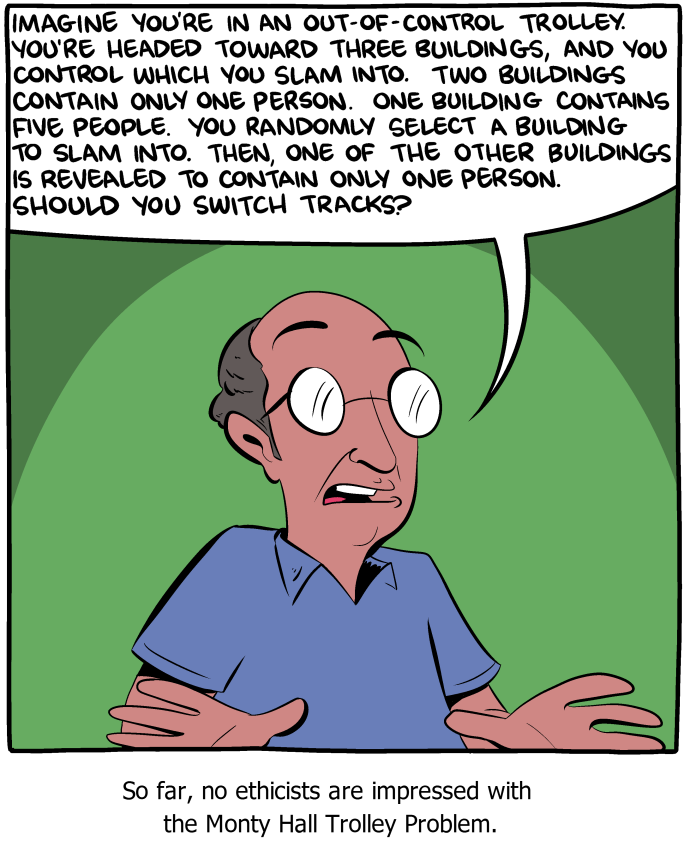
This week, strangely, two separate webcomics had panels about the "Monty Hall" problem.  At left is the Saturday Morning Breakfast Cereal comic; the Wondermark (which has the best solution I've ever heard to this question) is at the end of this post.

The "Monty Hall" problem is a riddle that is supposed to help demonstrate probability, I think. It first became 'famous' in 1990, when it was featured in a letter to Marilyn Vos Savant, who runs (ran?) a newspaper column.

Here is the way the problem is formulated: You are a contestant on "Let's Make a Deal." In the final round, you have a pick of 3 doors. Behind 1 is a prize. After you pick one, Monty opens 1 of the other 2 doors, and then gives you a choice: stick with your original door, or opt for the other, as yet unchosen and unopened door.

This problem was first formulated in 1975 or so but was based on an earlier problem from 1959.

Most "experts" say that you should definitely definitely switch.  They reason that when you first picked a door, you had a 1 in 3 chance of picking correctly, but that after Monty opens a door you have a 1 in 2 chance of picking correctly.

That result has been very controversial, as it goes against what our common sense tells us, and even great thinkers have argued with it (Mathematician Paul Erdos is said to have refused to believe the answer was correct until he saw a computer simulation of it.)

I think the answer is incorrect, and that switching does not improve the chances at all. I believe this because I think that the experts are wrong about your initial odds of being correct.

I wrote about this in a post back in 2008. The problem with the 'experts' analysis is that they assume Monty has changed something in your system.

He hasn't. And the reason he hasn't is a combination of what's known as "Magician's Choice" and the kind of thinking behind is that your final answer from Who Wants To Be A Millionaire?

It was from Robert Lynn Asprin's "Myth" books -- silly (but good) books about a magician named "Skeeve" who has various adventures -- that I learned about "magician's choice." "Magician's choice" is making the onlooker choose something without telling them why they're choosing -- giving them the illusion that they're making a choice and controlling the outcome when they are not at all doing that. Suppose I hold up my hands in fists. In the left is a $10 bill, and in the right is nothing. I tell you that I've got a $10 bill in one hand and say "Choose one." You say "Right," and I say "Okay, that's yours. You get nothing, I keep the $10." Now, suppose instead that you say "Left." All I do is say "Okay, that's the one I keep. The right is yours." You still get nothing, and because I run the game, you were always going to get nothing. I made it look like you were getting a choice but you had no choice. The game is rigged.

That's the first thing that helped me crack "The Monty Hall Problem". The second was "Who Wants To Be A Millionaire," which I used to love before it broke my heart. Remember how, when people played, they'd say "A" and Regis would say "Final answer?" and they'd have to say "Final answer" or they could switch? That's pretty important here. 

The reason it's important is because final answer and Magician's choice help demonstrate that  contestants only have the illusion of a 1-in-3 choice at the outset; their choice always 1-in-2 because Monty removes the third choice. That he does this after you've chosen doesn't matter: If you assume Monty will open a door, then the contestant always only had two doors to choose from.

A contestant looking at Doors 1, 2 and 3 thinks he has three choices. But he has only two, in reality, because Monty is going to remove one of those choices. One of the three doors, the one chosen by Monty, is already eliminated from his universe of options. He just doesn't know, yet, which door is eliminated from contention.

This is where Final answer comes in. On Millionaire a contestant could say "A" and Regis would give him a chance to switch: Is that your final answer? When Regis does that, the contestant has the same number of answers to choose from. Assuming he didn't eliminate wrong answers through a lifeline (I miss that show!) he has four possibilities: A, B, C, and D. When he said "A" and Regis says Is that your final answer? the contestant could switch to any of the other three. He has all of his options still open.

But in the Monty Hall problem, when the contestant gets to give a final answer, when given the option to switch, there are only two doors. Which means the contestant never had the option of picking one of the doors. It's as if Regis said "You can pick A, B, or C, but not D." The fact that the contestant doesn't know in advance that one door is ineligible doesn't change the fact that one door is, in fact, ineligible. The Magicians Choice applies: the contestant is given a choice without knowing the conditions of the choice.

A contestant, when looked at this way, makes a preliminary choice -- Door 1, say. Monty then removes Door 2 from the equation, and asks the contestant if he wants to switch.  Because Monty removed door 2 from the equation, it was never available in the first place.

There are other problems with the claim that switching is always best. People who say you should switch focus on the odds that the third, as yet unchosen door, is best based on the change in probabilities.

Probability is calculated by taking the number of outcomes in which the event will occur divided by the total number of possible outcomes, or:

P = n/t

(My nomenclature: P is the probability the event you want to happen, will happen. N is the total number of outcomes in which that event could occur; t is the total number of possible outcomes. So if you roll a die and want to predict the number of times a roll will result in a number higher than four, the probability is 1/3: N is 2 (the numbers 5 and 6) and T is 6 (all possible numbers you could roll. 2/6 = 1/3).

So in the Monty Hall problem, P (the car behind the door) is the event we want to happen. The odds of it being behind any door seem to be 1 in 3, which is where everyone goes wrong. Since 1 door cannot be chosen, the odds you will pick correctly are 1/2.

But even if the initial odds were 1/3 that you'd pick correctly, after Monty chooses, switching presents no better odds. This is because once Monty eliminates a door, he gives you a brand new choice.  This is, again, where you can see that you always only had two choices.  Just as in Final Answer, you are free to switch or stay. It is not a choice of picking the other door. It is a choice of picking either door.

If Contestant picks Door 1, and Monty opens Door 2, and then says Do you want to switch (Final answer?), Contestant now has a choice between two doors.  Phrasing it as do you want to switch helps invoke psychological conditions making it tougher on people (people tend to see value in a choice they've made even where there is none, for example.)

So when Monty says do you want to switch, the odds that the car is behind either door are 1/2. You have the same odds of winning by staying as by switching.

Picture this: I offer to give you $10 if you pick a coin toss correctly. You can have "Heads," or "Tails," or "Both." You're no dummy; you know it can't be both, so you say "Heads." I then say "All right, I'll tell you what. You can't pick "Both." Do you want to switch?" Only an idiot would say "Switch!" based on the assumption that I have somehow changed the odds. Heads and tails were equally likely all along; both was never in play. 

This analysis doesn't change if I flip the coin and hide the result from you. I flip it. You say heads. I say OK, now I'm eliminating the option of you choosing BOTH. Do you want to switch? 

This isn't a perfect comparison (because both cannot occur, so the probability of both is zero) but it helps demonstrate the problem with the experts' solution -- because the door that Monty opens cannot be chosen by the contestant. They just don't know that yet.

So, in "The Monty Hall Problem," your odds of winning are always 1 in 2 from the start. The third door is there to distract you and make you do dumb things like change doors, to give you the illusion that you are choosing more than you really are; you're making one choice between two doors.  It doesn't matter if you switch or not.


Thursday, June 09, 2016

Hillary Clinton is worth $31,300,000. But voting for or against her will not matter much because Democrats do not vote and do not understand how government works.

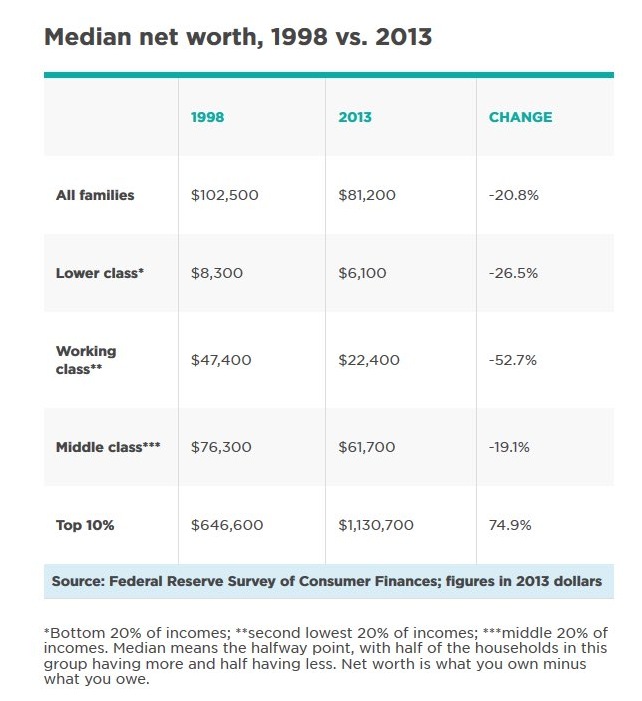
There is a chart that is making the rounds right now, and it's worth looking at but it also needs to be thought about more critically.

Here's the chart.


During the time span of this chart, Democrats held the presidency for 10 of the 18 years.

So it's worth noting that simply electing Hillary! not only won't change things because Hillary! is not a populist, not on the side of the middle-class or lower-class, and in fact doesn't understand the concept of irony, given that she recently wore a jacket that cost $12,495. 

She wore it while she gave a speech about income inequality.

But the real problem is that people focus on the presidency. During the time charted above, Democrats DEMOCRATS had control of the Senate for only 6 years (and one 2-year session was a 50-50 tie) and of the House of Representatives 4 of 18 years.

In the 1990s, the Democrats had control of both the House and the Senate for 6 years (1989-1995). Republicans were in charge the next 6, controlling both houses. From 1990-2000, Democrats controlled the presidency for 8 of 10 years.

During the 1990s, median household income overall rose in 49 of 50 states. In fact, household income rose steadily whenever Democrats were in charge. The charts where I got that data from show only overall household income, not broken down by bracket, so it's possible that the median income was rising simply because the wealthy were getting richer, but that's not exactly how medians work. (That's how AVERAGES work.)

With a median, if we take four people, with incomes of $1,000, $5,000, $5001, and $100,000, the median is $5,000.50, while the average is $27,750.

If the highest earner's income in that sample increases to $2,000,000, the median doesn't change. But the new average income is $502,000. In each case, the average misrepresents the real state of income, which is why averages are a horrible measurement. They tell you nothing.

The median changes only slightly, when there is a change near the middle. In our four-person example of $1k, $5k, $5001 and $100k, giving the $5001 guy a raise to $10,000 changes the median to $7,500. (In even-numbered sets the median is determined by averaging the two numbers at the center.)  If you add a fifth person to this new set, making $200,000, the median drops back down to $5,001 -- the point where the number of people on each side are the same.

So it's hard to move a median up very high just by adding to one end. 

Anyway, the real point is this: Congress controls the purse strings. Congress sets tax policy. Congress determines write-offs and loopholes. Congress determines that most hedge-fund investors pay a maximum income tax rate of 20% on their earnings from those investments.  (Which helps make the effective income tax rate on the highest earners a relatively nominal 23% or so, having fallen from 27% since 1979. As with incomes, the effective tax rates on the highest earners showed changes while the Democrats held Congress; the effective tax rate fell steadily since 1979 except for brief periods in the 1990s and 2000s more or less coincident with Democratic control of Congress -- and the latter period was under the Worst President Ever's administration.

Presidents can reject laws, and can be choosy about how to enforce them, but they cannot unilaterally change tax rates or wages or allocate more money to small business loans or change how student loans are collected and funded.  

CONGRESS can.

The Republicans have for nearly 50 years set their main strategy on getting control of legislatures. The Democrats focus on high-profile presidential races.  The Republicans control 2/3 of all state legislatures.   Those legislators set state tax policy, control school funding, control state business grants and frequently administer or allocate federal funds.  They also set the district maps for Congressional races, which is how the Republicans have made Congress so effectively theirs for a long time.

Democrats consistently fail to vote in mid-term elections. 1/3 of Congress is elected at a mid-term election.

Yes, yes, Hillary! helped further crack the glass ceiling. We elected the first African-American president 8 years ago and America is no better for it. Hillary! will not help, not just because she has no interest in changing the economic status quo, but also because Democrats aren't likely to change the legislative makeup this year. The Democrats would have to win 19 of the 27 state legislatures that are at risk of changing in 2016; 11 of the 27 are deemed relatively safe for the GOP.  So the Democrats will have to win the 16 that are generally considered gettable, and at least 3 of the ones nobody thinks the GOP will lose.

Democrats need to get 30 extra seats in Congress to take the House. in 2014, they got 15. The 188 Democrats sworn into the House after the 2014 midterms was the lowest the party has gotten since 1947.

Until Democrats bother voting for something other than president, the US will continue becoming more unequal.