It wasn't until the last, eponymous, story in this collection that I realized the theme that strung them all together, so I guess I might be slow on the uptake. The stories in Thunderstruck are about how we deal with loss, but the loss comes in all kinds of different varieties.
It's a bit of an uneven collection, despite all the praise it has received, and many of the stories feel like they miss the mark a bit. Reading these stories is something like hearing someone talk about a great book and feeling like maybe you've read it: you can recognize where the exciting or emotional parts are, but aren't quite sure they actually existed.
In Something Amazing, the loss is of children, one who died of lymphoma, the other who disappears one day, and the feelings they leave behind -- the mother of the dead girl believing she herself is sick, papering over the door to the girl's room in her grief, the brother left to pick up the pieces. This story is moving and interesting, and because it's not clear if the ghost mentioned in the story is meant to be literally a ghost in the story, or a metaphor, the story has a bit of a spectral element.
Property is about a sudden, young widower moving into a rundown rental house in America, and his efforts to rehab it. This story didn't stick with me much; the main character isn't very likeable and the story itself feels like the summarization of a novel. There are elements that are interesting but they're quickly glossed over, and every character except the main one feels more interesting than the protagonist.
Some Terpsichore on the other hand is almost brilliant: the story of a woman who sang like a saw, and how she accidentally became famous, is touching and unique, a fresh take on what is practically a genre (the broken-down ex-showgirl genre).
Juliet is an interesting story that doesn't quite make it to good. Centered around a woman who befriends a librarian (but told by someone other than the main characters), it doesn't really hit its peak until the very end. Like Property it feels like the better story was hidden behind all the set dressing the author focuses on; there is a very moving scene near the end that should have a wallop, but because it just feels dropped in there from another (better) story the impact is muted.
I did not like The House Of Two Three-Legged Dogs. Part of that was personal: I do not like stories of people who are broke and struggling for money and have trouble finding them entertaining. Even with that caveat though, the story wasn't much. It's about a husband and wife who are bankrupt, in France, and their son, whose name is on the title of their house, is going to sell the house to fix some (never really explained) situation of his own. The husband and wife have lots of pets, including 50 budgies, and they have an eccentric and drunk friend, Sid, and it's all supposed to be very moving, I think, but it felt rushed and forced. Also, I don't like 3-legged dogs, either, so this story really had no chance with me, even if it had been better.
One of the things, before moving on to other stories, that marks most of these stories so far is that in each story, the actual reason for the story seems to be approached only glancingly. As I re-think each story, it's like they are less-entertaining, less-thoughtful works based on better stories. If you've ever read (or seen performed) Rosencrantz & Guildenstern Are Dead, then you know the idea I'm getting at: it is possible to retell a story from the perspective of another character in the original story, and in doing so gain new insight into the old story as well as be entertained by the new.
That doesn't happen here, in part because there is no original story for us to know about. Instead, the stories that work are stories that deal with the best part of what's going on: Some Terpsichore, for example, focuses like a laser on the best part of that woman's story. Juliet, meanwhile, involves a murder and a heartbreak and a rabbit dying and a family in crisis and yet somehow none of it is interesting; it reads like a semithoughtful review of a movie about those things.
Hungry at least returns to the interesting stuff; the story of Lisa and her grandmother takes place all in one day, really, the 4th of July in the 1970s, while Lisa is spending time with her grandma as her dad is dying in the hospital. Lisa's plan to do Patrick Henry's speech, her love of sweets, the interaction with a neighbor and the grandma's heartbreak about her son are well-written. It's a good story, worth reading.
The Lost & Found Department of Greater Boston led me to start thinking about setting. Lots of these stories are set in and around Boston, it seemed; at least, the narrator occasionally managed an annoying BAHSTEN accent, which (sorry, Bostonians) generally made the characters seem less thoughtful, intelligent, and likeable. But the setting didn't even matter; I have no idea where Hungry or Some Terpsichore were set, and they were good stories. Setting should only be mentioned prominently, especially in a short story, if it matters for some reason, and I couldn't figure out why it would in any of these stories. Writers should keep in mind Chekhov's gun: don't mention things that aren't going to be important.
Anyway, this story is another one of those that misses the mark: it is primarily about a young boy whose mother disappears and he is starving in his house with his terrible grandfather, but as with the others, that's actually the least interesting part of the story. McCracken skips from character to character: the mom, the grocery store manager who helps the boy and thinks it might somehow change his own life, the police officer, more on the mom, a flashback to the night she left, until it's too much to take in so quickly. Then at the end McCracken returns to the grocery store manager, whose role in the matter was completely misunderstood by the boy, and the scene is again supposed to be a huge, devastating one, but because we've spent a million years on other people, it's muted. What could have been a heartbreaker of an ending is instead sort of Lifetime movieish.
Peter Elroy: A Documentary By Ian Casey is easily the worst story in the book. A man dying of pancreatic cancer is dropped off to visit a documentarian who made him look like an a**hole 30 years ago and destroyed his career as... an economics professor? Meh. It felt too forced and too quirky and too inexplicable, and at no point was there the opportunity (or reason) to care about "Peter Elroy" for any reason. He wasn't dramatically drawn enough for us to take some sort of bitter pleasure in his downfall (or downstay), but he wasn't making any effort to be more likeable or generate sympathy. I couldn't tell why this story was even in here, unless it was to pad out the page count.
The title story, Thunderstruck, is a B+ of a story, maybe A-, and also worth reading. A family takes a 5-week trip to Paris after their 12-year-old daughter is brought home from a party she snuck out of the house to go to, wearing just a t-shirt. The story itself manages a good setup of both dread and hope, and captures some family dynamics pretty well; the main characters are interesting and people you want to root for, even the 12-year-old. When things take a turn for the dramatic, the story even manages to up itself a notch.
It would be an A+ of a story but for two things: One, it feels again a bit rushed; McCracken should have let the story be a bit longer, maybe; there's a lot that happens, especially near the end, that apparently happens in a relatively short time, and it was jarring when she reminded me that it was such a short time. (I had the same feeling with The World According To Garp; sometimes writers have so much happen to a person and then they're all oh yeah by the way that was all in 3 weeks and it's too much; it pulls you out of the story while you're trying to work out the time sense.) But it's more than that: without spoiling what actually happens (because it's still worth reading), I can tell you that McCracken chooses sides.
The story boils down to the husband and wife of Helen, the 12-year-old, having differences of opinion about Helen and her life going forward; the mom has one (very depressing but realistic) view and the dad has another (hopeful and optimistic) view. How the dad realizes what the mom is telling him, and how he decides to look at it, is wonderful. Had McCracken left the story at that, she would have written a story worth remembering. But she cheats, and lets the reader know that the dad is right and the mom is wrong, in a way. This doesn't have the effect of making the dad braver or better, because the dad doesn't know it. He's not being brave, by not confronting the mom with what he knows. It's just McCracken, not trusting her readers to be ready to handle ambiguity, and so leading them like donkeys: oh by the way you need not think for yourself, here is what I will tell you.
That would be fine, except that the rest of the story actually requires us to not know what McCracken tells us, for the story to be great, for it to work. It's hard to explain fully without you having read it, but the point of the story seems to be that people can work through loss of any kind, even the loss of faith in a spouse caused by the revelation of who they are and how they affect our own dreams, even the loss of those dreams themselves, if we love enough -- even though we are not sure what, or who, we are loving about.
That's what I took to be the theme, anyway, and it would work great, but, again, McCracken takes away the ambiguity. Her story makes you want to side with the dad while also understanding the mom, and accepting her -- the way the dad does -- but she makes it okay for you to do that by telling you it's okay.
All in all, the stories were okay. It's not a waste of time to read it. I enjoyed all but two of the stories, at least a bit. But if I had to do it over again, I'd probably just read a few of them. McCracken has some talent, for sure, but she never quit hits the mark.
________________________
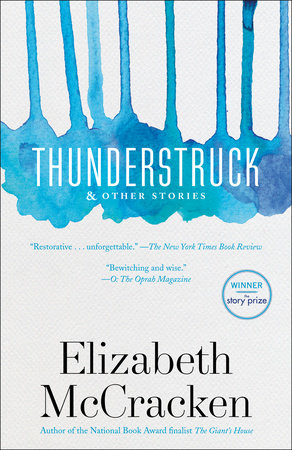
Weird synchonicity PS: This collection of short stories ends with a story in which art helps a person cope with a loss; the cover is (as you can see) an all-white cover with a blue line and seems like it's related to that story.
My collection of short stories, Just Exactly How Life Looks, ends with a story in which art helps a person cope with a loss; the cover is (as you can see) an all-white cover with a blue line which (I can tell you) is directly related to the last story.
Tuesday, July 19, 2016
Quotent Quotables: Next time I'll tell you about other gross problems I've had.
It was so hot you could hear the mayonnaise go bad.
-- Hungry, from "Thunderstruck, And Other Stories" by Elizabeth McCracken.
______________
Three times in my life I've eaten mayonnaise that's gone bad. The first time time was when we took a family trip to South Dakota as kids, and we had some food in a cooler to eat lunch with at a park. The mayo had turned, as they say, and we ate some and everyone got a bit sick. That trip wasn't memorable for that, but it was memorable for my mom expressing bitter disappointment in us kids when we visited Spearfish Falls, and she wanted us to go under the waterfall for a picture. The water was extremely cold, and we didn't want to, so we complained our way through the picture.
The other time was on Xmas Eve, when I went to my brother Bill's house the year he was going to host. Xmas Eve was a big deal in our family, and I'm not sure why Bill got to host it that year; traditionally, when we were kids, the event had traded back and forth between my parents and my Uncle Joe's house, as he and my mother engaged in a fierce rivalry to be the head of the family after my grandma died.
Bill had made some dip that he served in a bread bowl. I arrived in the afternoon and ate some, and then got violently sick on the way back to my 1-room apartment in the bad part of town. Later, I asked him how long the dip had been out. He said since the morning.
The third time was my fault. In law school, they'd been handing out free sandwiches for some group, and I took one (it was wrapped), put it in my backpack and later on transferred it to my 'fridge in my apartment in the bad part of town. The next morning I had it for breakfast, and it must have spoiled while in my backpack, because I got supersick again. Sweetie, who I was just dating then, came all the way from her house (about 60 miles away) to help take care of me. She always said I couldn't have had food poisoning because I either did, or didn't, have a fever. I don't remember which it was but whatever condition I had, Sweetie said was the opposite of food poisoning.
In the story, [SPOILER ALERT!] a grandma is taking care of a her granddaughter because the girl's dad -- grandma's son -- is in the hospital. The girl doesn't eat the mayo, but while they're at the party the dad dies in the hospital. Either way, mayo at a party seems like it's a bad sign.
As further proof of the evil qualities of mayo, consider this: when I first began dating Sweetie, I went to Thanksgiving at her parent's house, and I brought with me a can of jellied cranberries, my second-favorite thing about Thanksgiving. I suspect that my mother-in-law saw that as an insult, and has been trying to passive-aggressively pay me back since then for the (perceived) insult. (I only brought them because Sweetie said she made her own cranberry sauce, and I thought everyone [mostly me] should also have some that came from a can).
One year, she handed me a plate of what looked like jellied cranberries and said "Oh here, try some." When I got suspicious because serving canned cranberries was out of her nature I said What are they?
"Beets," she said, and I passed.
Another year, even worse, she presented a Jell-O (TM) mold, cranberry colored with white cream in the middle and orange flecks here and there. "It's cranberry Jell-O" she said. "I figured you'd like it."
I started to serve myself some and asked what the orange flecks were. "They're carrots," she said, before admitting that the center of the mold, the white stuff, was mayonnaise.
-- Hungry, from "Thunderstruck, And Other Stories" by Elizabeth McCracken.
______________
Three times in my life I've eaten mayonnaise that's gone bad. The first time time was when we took a family trip to South Dakota as kids, and we had some food in a cooler to eat lunch with at a park. The mayo had turned, as they say, and we ate some and everyone got a bit sick. That trip wasn't memorable for that, but it was memorable for my mom expressing bitter disappointment in us kids when we visited Spearfish Falls, and she wanted us to go under the waterfall for a picture. The water was extremely cold, and we didn't want to, so we complained our way through the picture.
The other time was on Xmas Eve, when I went to my brother Bill's house the year he was going to host. Xmas Eve was a big deal in our family, and I'm not sure why Bill got to host it that year; traditionally, when we were kids, the event had traded back and forth between my parents and my Uncle Joe's house, as he and my mother engaged in a fierce rivalry to be the head of the family after my grandma died.
Bill had made some dip that he served in a bread bowl. I arrived in the afternoon and ate some, and then got violently sick on the way back to my 1-room apartment in the bad part of town. Later, I asked him how long the dip had been out. He said since the morning.
The third time was my fault. In law school, they'd been handing out free sandwiches for some group, and I took one (it was wrapped), put it in my backpack and later on transferred it to my 'fridge in my apartment in the bad part of town. The next morning I had it for breakfast, and it must have spoiled while in my backpack, because I got supersick again. Sweetie, who I was just dating then, came all the way from her house (about 60 miles away) to help take care of me. She always said I couldn't have had food poisoning because I either did, or didn't, have a fever. I don't remember which it was but whatever condition I had, Sweetie said was the opposite of food poisoning.
In the story, [SPOILER ALERT!] a grandma is taking care of a her granddaughter because the girl's dad -- grandma's son -- is in the hospital. The girl doesn't eat the mayo, but while they're at the party the dad dies in the hospital. Either way, mayo at a party seems like it's a bad sign.
As further proof of the evil qualities of mayo, consider this: when I first began dating Sweetie, I went to Thanksgiving at her parent's house, and I brought with me a can of jellied cranberries, my second-favorite thing about Thanksgiving. I suspect that my mother-in-law saw that as an insult, and has been trying to passive-aggressively pay me back since then for the (perceived) insult. (I only brought them because Sweetie said she made her own cranberry sauce, and I thought everyone [mostly me] should also have some that came from a can).
One year, she handed me a plate of what looked like jellied cranberries and said "Oh here, try some." When I got suspicious because serving canned cranberries was out of her nature I said What are they?
"Beets," she said, and I passed.
Another year, even worse, she presented a Jell-O (TM) mold, cranberry colored with white cream in the middle and orange flecks here and there. "It's cranberry Jell-O" she said. "I figured you'd like it."
I started to serve myself some and asked what the orange flecks were. "They're carrots," she said, before admitting that the center of the mold, the white stuff, was mayonnaise.
Sunday, July 17, 2016
Update On The Economy: Have a Coke(TM) and a frown.
When I was a kid, my dad worked for a local bottling company branch of Coca Cola. He was intensely loyal to Coke. When we went out to eat, he would ask for a Coke as his beverage. "Is Pepsi okay?" the waiter would sometimes ask. "No, it's not," he'd say, and embarrass us kids by telling the waiter that he worked for Coke and Coke was better.
People love their brands. That's why there are brands. Everything, right down to movie stars, sports teams, and authors, are brands. (If you doubt that, consider this: What is a John Grisham novel like? What kind of people root for the Pittsburgh Steelers? Are you likely to enjoy a movie starring Tom Hanks? You have answers to those questions, because those things are brands.)
Here is a chart (from Sploid) of who owns what brands:
My dad loved Cheetos, among other snack foods. My dad was a Coke man eating a Pepsi snack.
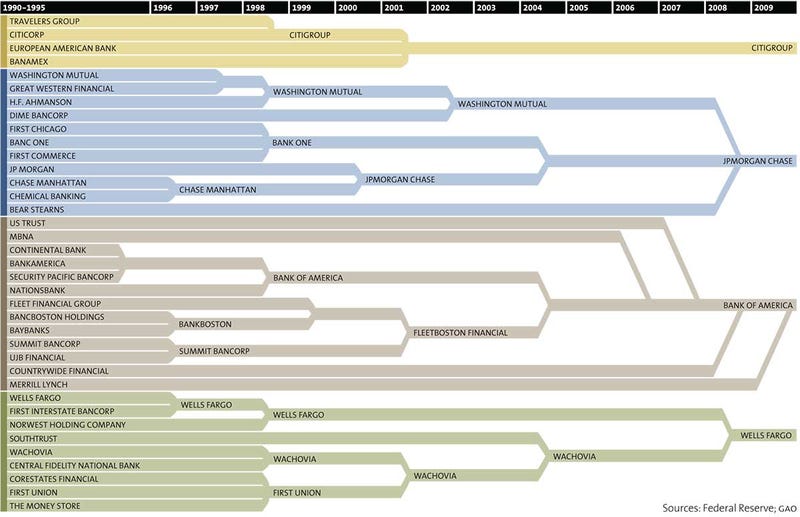
But it's even worse than you think. It's one thing to not realize you're enriching Pepsi even while preaching from your soapbox about how Coke is better. Consider this chart (same source) of the mergers of financial institutions in the past few years:
54% of all money is now held in the hands of four corporations. Those four corporations are routinely ranked among the worst companies. JPMorganChase, among recent malfeasance, was forced by the Consumer Financial Protection Bureau last year to admit that it routinely collected money it wasn't owed from credit card customers-- or sold that debt to collectors who hounded people and got judgments against them for money they didn't owe or which they shouldn't have had to pay back.
If you got a credit card in the past 15 years, odds are you are now a JPMorganChase customer. I wish you luck. Call me when they screw up your home mortgage and spend 5 years and $100,000 trying to force you out of your house.
But hey, when life gets rough, lose yourself in some entertainment. Sploid has provided this chart to guide you:
Scorecard so far:
10 companies control about 90% of all food and beverages.
6 companies control 90% of entertainment.
4 companies control 54% of money.
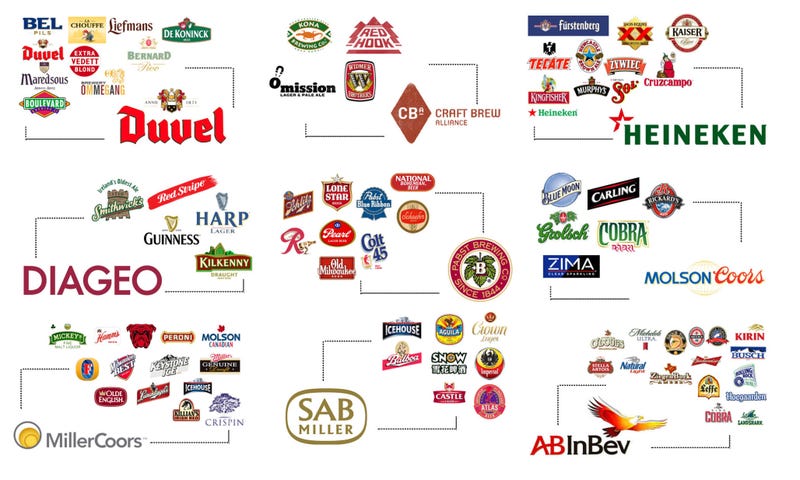
I'm not a drinker, but I do see liquor and beer ads all the time, trying to get you to buy a particular brand of alcohol. Turns out it doesn't matter much:
That doesn't count the 83 zillion 'brewpubs' and 'microbreweries' that have been started by optimistic enterpreneurs in the last few years, of course. Sadly, most of those will fail. Those that don't will simply be absorbed by megalithic corporations. (I chose that word deliberately.) Last year, for Xmas, ABInDev (still called Bud even by business writers) bought itself three craft breweries as a nice little gift.
Here's an interesting factoid: Stella Artois, which you may have heard about in commercials recently, was for a long time a snobbish beer. Then it became beloved by soccer hooligans and people the brewer thought of as low-class. So they rebranded it with those ads showing how carefully its glasses are made, and featuring Adrian Brody. Stella Artois didn't want to be associated with blue-collar drinking.
Or so you thought, because ABInBev owns both Stella Artois and Natural Light. "Natty Light" is primarily drunk by younger people because it's cheap.
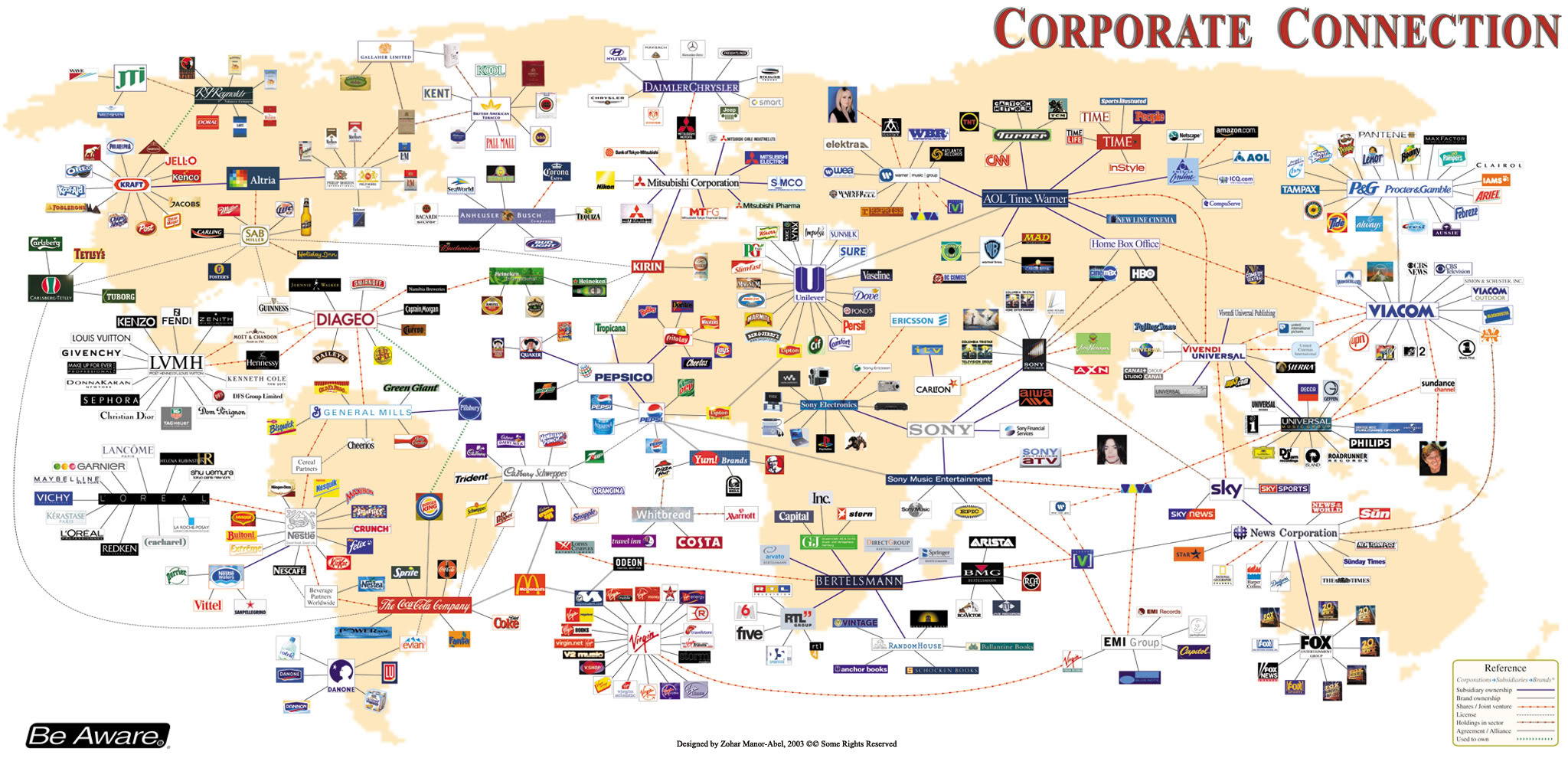
Are you a Stella Artois man in a Natty Light world? You are:
You'll probably have to embiggen that to understand it, but let me trace just one line for you. AOLTimeWarner has a 'strategic partnership' which is used to promote Unilever brands through AOLTimeWarner media properties.
Unilever "joined forces" (it's weird, the way these stories keep sounding like the status of nation-states prior to WWI) with PepsiCo about 15 years ago to help spread the consumption of tea.
PepsiCo, meanwhile, connects to The Coca-Cola Company through some hotel chains and Virgin airlines by way of McDonald's. You can follow the links yourself, too, to find out what companies you hate but are secretly doing business with. But making a purchase from Amazon.com, like the butterfly's fabled wings, impacts my ownership of a Smart car.
This all matters beyond simply making it hard to tell which company you should be feuding with, or how you can avoid doing business with companies whose practices you don't approve of (you can't, short answer).
The Sherman AntiTrust Act, a/k/a "the part of history class you slept through" was passed in 1890, just eleven years after a lawyer (of course!) helped devise a new method of corporate ownership on behalf of an oil company (of course!). 24 years later the Act was updated, so that by 1914 it limited price-fixing, 'tie in' and exclusive deals, and "mergers and acquisitions that substantially reduce market competition."
Look again at those charts. Would combining 53 companies into 6 "substantially reduce market competition?" If you said no, then congratulations, you are a federal regulator; and also you haven't noticed that much of entertainment looks a lot like the rest of entertainment.
Enforcement of the Act has been harder in recent years, due in part to a US Supreme Court case that you haven't heard of (because it hasn't been hyped by major political parties, who use social issues to get you to ignore real issues) called Bell Atlantic Corp. v. Twombly. This case announced a new rule that made it easier for defendants to dismiss federal claims against them without first going through the litigation (in litigation, a complaint -- the piece of paper filed to start a lawsuit -- can dismissed if there is no chance the plaintiff could succeed on his case. Dismissal at this stage used to be rare, as litigants were allowed to use legal process to build a case. Now it is common that cases are dismissed without a hearing, without evidence being produced by a defendant, and without much attention at all.)
Twombly was an attempt at a class action lawsuit alleging that major telecommunication companies were raising prices by (among other allegations) simply not entering markets where another company was dominant, so as to avoid a price war. This was alleged to have disadvantaged small businesses -- you know, the type of business that we as Americans lionize. The complaint was dismissed without any hearings, and now we don't know whether the price you pay for your phone is fair.
(Twombly had the effect of getting huge swaths of litigation dismissed, and also complicating [and hence raising the price of] litigation, but efforts to legislatively overrule it never even got to a vote in Congress.)
Sometimes price-fixing occurs overtly, like when Apple conspired with the "Big Six" publishers to make ebooks more expensive (driven primarily by Steve Jobs' personal dislike of Amazon's Jeff Bezos; like in ancient times, gods living high above mortals may quarrel, and the mortals suffer the excess effects of their wrath.) Apple, the only company which didn't settle, had to pay $450,000,000 as a result. That fine became final in March, 2016. In April, 2016, Apple reported it made $10,500,000,000 in profits in the second quarter of 2016 alone. That's profits. Gross receipts that quarter -- over three months -- were $50,600,000,000.
For the first 100 years of antitrust law, the US had the most vigorous antitrust efforts in the world. But antitrust litigation has steadily fallen off since 1971. Here, the problem is not Republican control of Congress; it is Republican control of the courts. The Twombly decision was engineered by judges put on the Court by Republicans.
George W. Bush, the worst president ever, appointed 327 judges to the federal bench -- or about 40 a year. (Barack Obama has been able to get 329 confirmed, so the general grousing about not moving his nominees through seems a bit overrated.)
The current US Supreme Court makeup has 4 justices appointed by Republicans, 4 by Democrats. This is the highest ratio of Democrat appointments-to-Republican appointments since 1968 -- about when antitrust litigation began to slow down. Since 1968, Republicans have controlled the presidency for 28 of the 48 years. Presidents do not just appoint judges; they dictate priorities for the Department of Justice, which brings antitrust suits.
Relatively few cases make it to the US Supreme Court. Currently, 94 federal intermediate appellate court judges were appointed by Democrats, with 79 coming from Republicans. That is the highest such ratio since 2000, and only 3 times since 1980 have the majority of federal, intermediate-level, appellate judges been appointed by Democrats.
At the district court, or lowest level -- the place most rulings are made -- the current makeup is 53% appointed by Democrats, 47% appointed by Republicans. That is only the second time since 1980 that the majority of sitting federal judges were appointed by Democrats.
Federal judges are not elected. They serve for a lifetime unless impeached. Federal judges wield enormous power, and the combination of lax enforcement by an executive and restrictive litigation rules by the judiciary might be the reason that when you buy a Coke, Pepsi makes money.
People love their brands. That's why there are brands. Everything, right down to movie stars, sports teams, and authors, are brands. (If you doubt that, consider this: What is a John Grisham novel like? What kind of people root for the Pittsburgh Steelers? Are you likely to enjoy a movie starring Tom Hanks? You have answers to those questions, because those things are brands.)
Here is a chart (from Sploid) of who owns what brands:
My dad loved Cheetos, among other snack foods. My dad was a Coke man eating a Pepsi snack.
But it's even worse than you think. It's one thing to not realize you're enriching Pepsi even while preaching from your soapbox about how Coke is better. Consider this chart (same source) of the mergers of financial institutions in the past few years:
54% of all money is now held in the hands of four corporations. Those four corporations are routinely ranked among the worst companies. JPMorganChase, among recent malfeasance, was forced by the Consumer Financial Protection Bureau last year to admit that it routinely collected money it wasn't owed from credit card customers-- or sold that debt to collectors who hounded people and got judgments against them for money they didn't owe or which they shouldn't have had to pay back.
If you got a credit card in the past 15 years, odds are you are now a JPMorganChase customer. I wish you luck. Call me when they screw up your home mortgage and spend 5 years and $100,000 trying to force you out of your house.
But hey, when life gets rough, lose yourself in some entertainment. Sploid has provided this chart to guide you:
Scorecard so far:
10 companies control about 90% of all food and beverages.
6 companies control 90% of entertainment.
4 companies control 54% of money.
I'm not a drinker, but I do see liquor and beer ads all the time, trying to get you to buy a particular brand of alcohol. Turns out it doesn't matter much:
That doesn't count the 83 zillion 'brewpubs' and 'microbreweries' that have been started by optimistic enterpreneurs in the last few years, of course. Sadly, most of those will fail. Those that don't will simply be absorbed by megalithic corporations. (I chose that word deliberately.) Last year, for Xmas, ABInDev (still called Bud even by business writers) bought itself three craft breweries as a nice little gift.
Here's an interesting factoid: Stella Artois, which you may have heard about in commercials recently, was for a long time a snobbish beer. Then it became beloved by soccer hooligans and people the brewer thought of as low-class. So they rebranded it with those ads showing how carefully its glasses are made, and featuring Adrian Brody. Stella Artois didn't want to be associated with blue-collar drinking.
Or so you thought, because ABInBev owns both Stella Artois and Natural Light. "Natty Light" is primarily drunk by younger people because it's cheap.
Are you a Stella Artois man in a Natty Light world? You are:
You'll probably have to embiggen that to understand it, but let me trace just one line for you. AOLTimeWarner has a 'strategic partnership' which is used to promote Unilever brands through AOLTimeWarner media properties.
Unilever "joined forces" (it's weird, the way these stories keep sounding like the status of nation-states prior to WWI) with PepsiCo about 15 years ago to help spread the consumption of tea.
PepsiCo, meanwhile, connects to The Coca-Cola Company through some hotel chains and Virgin airlines by way of McDonald's. You can follow the links yourself, too, to find out what companies you hate but are secretly doing business with. But making a purchase from Amazon.com, like the butterfly's fabled wings, impacts my ownership of a Smart car.
This all matters beyond simply making it hard to tell which company you should be feuding with, or how you can avoid doing business with companies whose practices you don't approve of (you can't, short answer).
The Sherman AntiTrust Act, a/k/a "the part of history class you slept through" was passed in 1890, just eleven years after a lawyer (of course!) helped devise a new method of corporate ownership on behalf of an oil company (of course!). 24 years later the Act was updated, so that by 1914 it limited price-fixing, 'tie in' and exclusive deals, and "mergers and acquisitions that substantially reduce market competition."
Look again at those charts. Would combining 53 companies into 6 "substantially reduce market competition?" If you said no, then congratulations, you are a federal regulator; and also you haven't noticed that much of entertainment looks a lot like the rest of entertainment.
Enforcement of the Act has been harder in recent years, due in part to a US Supreme Court case that you haven't heard of (because it hasn't been hyped by major political parties, who use social issues to get you to ignore real issues) called Bell Atlantic Corp. v. Twombly. This case announced a new rule that made it easier for defendants to dismiss federal claims against them without first going through the litigation (in litigation, a complaint -- the piece of paper filed to start a lawsuit -- can dismissed if there is no chance the plaintiff could succeed on his case. Dismissal at this stage used to be rare, as litigants were allowed to use legal process to build a case. Now it is common that cases are dismissed without a hearing, without evidence being produced by a defendant, and without much attention at all.)
Twombly was an attempt at a class action lawsuit alleging that major telecommunication companies were raising prices by (among other allegations) simply not entering markets where another company was dominant, so as to avoid a price war. This was alleged to have disadvantaged small businesses -- you know, the type of business that we as Americans lionize. The complaint was dismissed without any hearings, and now we don't know whether the price you pay for your phone is fair.
(Twombly had the effect of getting huge swaths of litigation dismissed, and also complicating [and hence raising the price of] litigation, but efforts to legislatively overrule it never even got to a vote in Congress.)
Sometimes price-fixing occurs overtly, like when Apple conspired with the "Big Six" publishers to make ebooks more expensive (driven primarily by Steve Jobs' personal dislike of Amazon's Jeff Bezos; like in ancient times, gods living high above mortals may quarrel, and the mortals suffer the excess effects of their wrath.) Apple, the only company which didn't settle, had to pay $450,000,000 as a result. That fine became final in March, 2016. In April, 2016, Apple reported it made $10,500,000,000 in profits in the second quarter of 2016 alone. That's profits. Gross receipts that quarter -- over three months -- were $50,600,000,000.
For the first 100 years of antitrust law, the US had the most vigorous antitrust efforts in the world. But antitrust litigation has steadily fallen off since 1971. Here, the problem is not Republican control of Congress; it is Republican control of the courts. The Twombly decision was engineered by judges put on the Court by Republicans.
George W. Bush, the worst president ever, appointed 327 judges to the federal bench -- or about 40 a year. (Barack Obama has been able to get 329 confirmed, so the general grousing about not moving his nominees through seems a bit overrated.)
The current US Supreme Court makeup has 4 justices appointed by Republicans, 4 by Democrats. This is the highest ratio of Democrat appointments-to-Republican appointments since 1968 -- about when antitrust litigation began to slow down. Since 1968, Republicans have controlled the presidency for 28 of the 48 years. Presidents do not just appoint judges; they dictate priorities for the Department of Justice, which brings antitrust suits.
Relatively few cases make it to the US Supreme Court. Currently, 94 federal intermediate appellate court judges were appointed by Democrats, with 79 coming from Republicans. That is the highest such ratio since 2000, and only 3 times since 1980 have the majority of federal, intermediate-level, appellate judges been appointed by Democrats.
At the district court, or lowest level -- the place most rulings are made -- the current makeup is 53% appointed by Democrats, 47% appointed by Republicans. That is only the second time since 1980 that the majority of sitting federal judges were appointed by Democrats.
Federal judges are not elected. They serve for a lifetime unless impeached. Federal judges wield enormous power, and the combination of lax enforcement by an executive and restrictive litigation rules by the judiciary might be the reason that when you buy a Coke, Pepsi makes money.
Subscribe to:
Posts (Atom)