I was in a rut between audiobooks. I'd started listening to Dune but the borrowing period expired, so while I waited for it to come around again I couldn't pick a new book to listen to. Finally I settled on So Long And Thanks For All The Fish, figuring it'd been years since I read it so I might enjoy it all over again the way I have a bunch of books this year.
Unfortunately, I didn't enjoy it all that much, and that's pretty much consistent with how I remembered the book in the first place, as it turns out. When I first downloaded it I could recall only what I thought were the basics of the storyline, about Arthur Dent returning to Earth, which has been mysteriously undemolished, and falling in love with Fenchurch, who was the girl from the first book who had an idea that would make everyone get along. But I thought there must be more to it than that, so I gave it another whirl.
Only there really isn't more to it than that. Arthur comes home, falls in love and he and Fenchurch go visit Wonko The Sane, only to find out that he can't really help them figure out what it was Fenchurch thought of before the demolition, so they go see God's last message to his creations, where they run into Marvin who [SPOILER ALERT] dies.
There's also a subplot with Ford Prefect that honestly didn't seem to matter in the book at all, other than to include Ford, which if you're not going to put in Zaphod and others, why insist on having Ford.
So Long isn't a bad book, per se, but it's not anywhere near the same league as the first three books in the Hitchhiker trilogy; it's not just the utter lack of any sort of plot really, but the fact that this book, tonally, just doesn't fit with the rest of the books. It's not the kind of outrageous, madcap, anything-can-happen book that people who read the first three will be expecting. It's more thoughtful and more pensive, and seems to be trying harder for the weirdness and funny asides of the first three books.
I went and read about the book and Adams' thoughts on it, and learned on Wikipedia that Adams himself wasn't very happy with the book, which was produced under some pressure to comply with a timeline. I also, in reading that entry, remembered that there was an installlment after So Long, the fifth installment, Mostly Harmless, which I sort of vaguely recall reading, I think? I'm pretty sure I read it.
Anyway, it's hard to understand why So Long is so markedly different and disappointing. Later books he wrote -- the Dirk Gently novels -- managed to recapture some of the spirit (The Long Dark Teatime Of The Soul being the better and less bewildering of the two), so my guess is that it was just that the Hitchhiker characters had run their course: there wasn't much left for them to do, I think.
But beyond that, too, the book doesn't actually answer the questions it sets out to answer. Fenchurch, for example, was trying to figure out what it was she'd thought of before the Earth was demolished, and when she sees God's last message she seems to think that answers her question (or at least she feels better) but it's hard to see how the message helps her. Marvin's ending is disappointing, as well; Marvin The Paranoid Android is one of the greatest characters ever created in literature, and to have him show up in the final chapter of the book and essentially just peter out is a letdown; the Marvin who was furiously stomping in circles in the mattress swamps, or the Marvin who had to pilot the ship into the sun, is the Marvin readers should have been allowed to see. It just felt wrong for Marvin to be so pathetic; in the past, Marvin was miserable and depressed and had the pain all down the diodes, etc., but he owned it, instead of being victimized by it.
Ford Prefect, also, moves beyond being Ford Prefect: the old Ford only helped people out by accident, and otherwise just wanted a good time. The new Ford tries to bankruptcy the Sirius Cybernetic Corporation, among other things he does that seem to be out of character for Ford.
The problem isn't so much that those characters change; characters growing or changing is okay. It's just that the new versions of them aren't funny, so the fact that they're different is just jarring, rather than showing some sort of literary merit.
Arthur and Fenchurch, though, to be fair, manage to work as a couple, and possibly the tone of the book is (as some critics have said) affected by the fact that it's more of a romance than a book about wacky space adventures, but the problem with that thinking is that Arthur and Fenchurch still have wacky space adventures, or at least wacky space-adjacent adventures, like going to visit Wonko or hitching a ride on a UFO or meeting the Rain God, and yet there is a distinct lack of wackiness to these adventures.
Mostly the book feels a lot like the final season of Arrested Development: inessential, tone-deaf, and harmful, in a way, to the rest of the series. I'm not one of those guys who thinks that you can destroy an earlier book by writing a later book; the existence of So Long... doesn't make the three previous books any less great; what it does is make people who read them say stuff like "Read the first three and skip the last two," and take a great series from great to 60% great. I wish I'd gone back and listened to Hitchhiker instead.
Good song, though:
Monday, November 07, 2016
Sunday, November 06, 2016
Book 75: Or if you don't like Star Wars references, you could think of it as being like if Frodo got to the Cracks Of Doom but Sauron had died of old age and the One Ring turned out to be just sort of a MacGuffin.
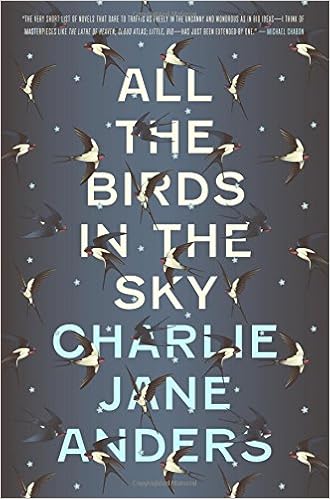
In the end, I wanted more out of All The Birds In The Sky.
All The Birds In The Sky as a book feels a lot like its protagonists: always reaching for something more, and not sure if they've made it there yet. The book is good. Too good to feel as light as it does, which is why I wanted more. It's a good book that feels like it should have been a great book.
The plot is this: Patricia, as a young girl, learns that she may be a witch when a bird talks to her and takes her to the Tree, where all the birds meet and pose a question to her. Her potential witch status makes her something of an outcast, and causes her to bond with Laurence, whose own unhappiness and focus on science makes him an outsider, too. Never really friends but not quite enemies, Laurence and Patricia form a unique bond that carries them through most of high school before their paths diverge.
From there, it's a small [SPOILER ALERT] to tell you that their paths meet up again as the possible end of the world is looming: the two are on opposite sides, each of which faction has its own, possibly terrible, idea about how to solve all the problems in the world.
There's a lot to love about this book: Anders creates a system of magic that is deceptively awesome in its simplicity, and throws in the kind of true-seeming science that books like this rely on, both without getting caught up in all the arcana that, say, Lev Grossman's Magicians series does with magic or Larry Niven might for science. There are touches of humor, too, throughout the book, which give it the kind of light quality that allows the book to deal with serious (and sometimes dark) themes and scenes. All of this is good, and what makes it a good book.
The downfall, though, is the book feels underdeveloped, or perhaps rushed, or both. At times, I wondered if maybe it was intended as a YA book; it felt simple in a not-bad way, simple the way the Narnia books sometimes felt simple, but at other times it felt rushed, or as though something had been cut out. I wondered after I finished it if maybe the publisher hadn't made the book be cut back to fit a page length that it thought we be more economical or something. It has that feel to it. There's a lot of stuff in the book that feels exposition-y or voiced-over, like Laurence's romance with another girlfriend throughout the book; the entire relationship feels like an example of tell rather than show, the way you might if you really wanted the readers to know something, but had a time limit.
Then there is the story of Theodolphus Rose, a master assassin who enters the story with plans to kill Patricia and Laurence while they're still young, because he's foreseen them destroying the world; after a major buildup with Rose, his storyline just peters out in a way that feels almost entirely unconnected to the first part of the story. Had Rose been cut out of the story entirely I think the book would be no worse for it, which says a lot about a master assassin who takes a job as a guidance counselor.
There are also minor things that don't fit in, like two of the more powerful witches, one who does spells by telling stories, a magic that nobody else has, and one whose mere presence causes anything biological to grow crazily. These two characters are brought in and out as needed, and the fact that their magic is so different from everyone else's goes unexplained.
Near the end, I started to think that this was maybe book 1 of a series, and that the feeling I was getting from the book was the way I feel when confronted with an origin story: it needs to be gotten over with, if told at all. (I think origin stories are often unnecessary but that's for another day.) I'd have liked that a lot better than having the finale to the story compressed into the final 10% or so of the book.
Then there is the ending: although it plays into the setup and beginnings of the characters, the way it comes off is a bit deus ex machina ish. I won't spoil it for anyone who wants to read the book, but I found the ending a bit unsatisfying given everything that had come before. The book set up some pretty high stakes, only to have them not matter at all in the end; to get the effect of what I'm talking about, imagine that after everything that happened in Star Wars, instead of the rebels assaulting the Death Star, it simply blows up as it exits hyperspace and Princess Leia gives Han the money to pay off Jabba because the rebels just saved so much in not having to fight. While not the same thing as what happens in All The Birds, the feeling is the same.
I don't mean to run it down too much; the book is still a good one. I enjoyed reading it, but it never felt like it rose above standard fantasy/scifi fare. But for all that, Anders is a very good writer, and has some obviously great ideas, ideas that would have been better served with a book that more fully explored them instead of a book that just felt like it had to hit its marks on time.
All The Birds In The Sky as a book feels a lot like its protagonists: always reaching for something more, and not sure if they've made it there yet. The book is good. Too good to feel as light as it does, which is why I wanted more. It's a good book that feels like it should have been a great book.
The plot is this: Patricia, as a young girl, learns that she may be a witch when a bird talks to her and takes her to the Tree, where all the birds meet and pose a question to her. Her potential witch status makes her something of an outcast, and causes her to bond with Laurence, whose own unhappiness and focus on science makes him an outsider, too. Never really friends but not quite enemies, Laurence and Patricia form a unique bond that carries them through most of high school before their paths diverge.
From there, it's a small [SPOILER ALERT] to tell you that their paths meet up again as the possible end of the world is looming: the two are on opposite sides, each of which faction has its own, possibly terrible, idea about how to solve all the problems in the world.
There's a lot to love about this book: Anders creates a system of magic that is deceptively awesome in its simplicity, and throws in the kind of true-seeming science that books like this rely on, both without getting caught up in all the arcana that, say, Lev Grossman's Magicians series does with magic or Larry Niven might for science. There are touches of humor, too, throughout the book, which give it the kind of light quality that allows the book to deal with serious (and sometimes dark) themes and scenes. All of this is good, and what makes it a good book.
The downfall, though, is the book feels underdeveloped, or perhaps rushed, or both. At times, I wondered if maybe it was intended as a YA book; it felt simple in a not-bad way, simple the way the Narnia books sometimes felt simple, but at other times it felt rushed, or as though something had been cut out. I wondered after I finished it if maybe the publisher hadn't made the book be cut back to fit a page length that it thought we be more economical or something. It has that feel to it. There's a lot of stuff in the book that feels exposition-y or voiced-over, like Laurence's romance with another girlfriend throughout the book; the entire relationship feels like an example of tell rather than show, the way you might if you really wanted the readers to know something, but had a time limit.
Then there is the story of Theodolphus Rose, a master assassin who enters the story with plans to kill Patricia and Laurence while they're still young, because he's foreseen them destroying the world; after a major buildup with Rose, his storyline just peters out in a way that feels almost entirely unconnected to the first part of the story. Had Rose been cut out of the story entirely I think the book would be no worse for it, which says a lot about a master assassin who takes a job as a guidance counselor.
There are also minor things that don't fit in, like two of the more powerful witches, one who does spells by telling stories, a magic that nobody else has, and one whose mere presence causes anything biological to grow crazily. These two characters are brought in and out as needed, and the fact that their magic is so different from everyone else's goes unexplained.
Near the end, I started to think that this was maybe book 1 of a series, and that the feeling I was getting from the book was the way I feel when confronted with an origin story: it needs to be gotten over with, if told at all. (I think origin stories are often unnecessary but that's for another day.) I'd have liked that a lot better than having the finale to the story compressed into the final 10% or so of the book.
Then there is the ending: although it plays into the setup and beginnings of the characters, the way it comes off is a bit deus ex machina ish. I won't spoil it for anyone who wants to read the book, but I found the ending a bit unsatisfying given everything that had come before. The book set up some pretty high stakes, only to have them not matter at all in the end; to get the effect of what I'm talking about, imagine that after everything that happened in Star Wars, instead of the rebels assaulting the Death Star, it simply blows up as it exits hyperspace and Princess Leia gives Han the money to pay off Jabba because the rebels just saved so much in not having to fight. While not the same thing as what happens in All The Birds, the feeling is the same.
I don't mean to run it down too much; the book is still a good one. I enjoyed reading it, but it never felt like it rose above standard fantasy/scifi fare. But for all that, Anders is a very good writer, and has some obviously great ideas, ideas that would have been better served with a book that more fully explored them instead of a book that just felt like it had to hit its marks on time.
Subscribe to:
Posts (Atom)