Monday, October 26, 2015

10 Minutes About All The Various Books I Have Been Reading (Or Not Reading)

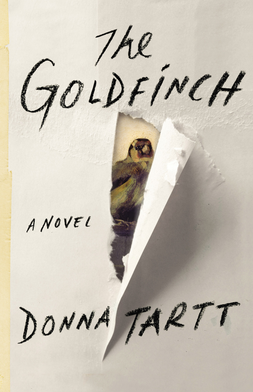
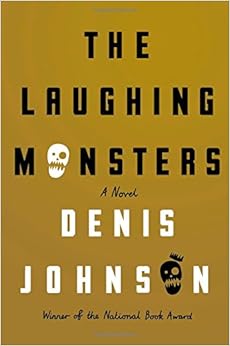
So I haven't done this post in a bit and I thought I could just sum up and talk in general about all the books, starting with the two I just started:  The Goldfinch by Donna Tartt, and The Laughing Monsters by Denis Johnson.

I started reading The Goldfinch because of controversy. I heard a lot about it last year when it won the Pulitzer Prize, but that wouldn't have made me want to read it.  What made me think about reading it was the discussion over whether it was really a good book at all; this article sums up the discussion, and when I read about why people were arguing about whether it was a good or bad book I decided to give it a try. I'm only about 2 chapters in but so far it's good.

The Laughing Monsters has an even thinner reason for reading it, or thicker, depending. I picked it up solely because I loved Denis Johnson's collection of short stories, Jesus' Son. I've said before that Denis Johnson writes stories as if he were doing a gritty reboot of Damon Runyon's world: the same gangters and crime background but where Runyon's are colorful and fun, Johnson's are desperate and sad and lonely.  I have no idea what The Laughing Monsters, a novel Johnson wrote, is about: I'm only two chapters into that, too (on audiobook) but it doesn't matter: already it's gripping. I first put it on when I took Mr F for his ride last night and I thought about extending the ride out to continue listening. It helps that it's set in Africa and involves (apparently) some sort of criminal. I like books set in Africa. (I read Foreign Gods, Inc. a while back and liked that, too, although it's very different from Johnson.)
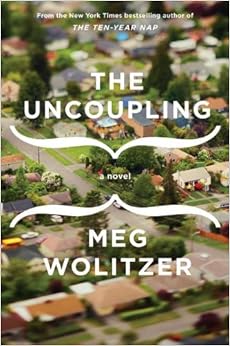
I got to Laughing Monsters after I rejected, on audiobook, Funny Girl by Nick Hornby. Hornby wrote one of my favorite books ever (A Long Way Down) and some other good ones (How To Be Good, Juliet, Naked) but this book got some bad reviews and about twenty minutes in, I wasn't entertained by the story of a woman who is beautiful but who wants to be a comedienne.  I also started but gave up on The Uncoupling, by Meg Wolitzer, a book that had an interesting premise but which fell apart so much that I didn't even bother finishing how it ended.

The Uncoupling is about a town in which all the women decide to stop having sex with men, about the time a drama teacher decides to stage a play of Lysistrata at the local high school. That sounds kind of hamhanded, and it is. The book is the sort in which a character nobody likes because she is unpleasant is actually named Abby Means. It has the feel of a book that wants to have a message, but the message (if there is one) is muddled.
I don't feel that every book must convey a theme or have a higher point or a moral or whatever; I read plenty of books whose main point is tell a story.  But The Uncoupling was draped in all sorts of symbolism that felt half-baked and overwrought at the same time. There is a veteran of Afghanistan, a kid just out of high school, who dropped out when his girlfriend got pregnant and who later went to war and had his face ruined, and he sort of on-the-spot befriends the hottest girl in school who on-the-spot decides that her refusal to have sex will be a protest of the war in Afghanistan, which causes another character to take the hot girl's role as Lysistrata, only to have her big night ruined (sort of) by all the men in the audience coming on stage to complain that they love their wives so much, why can't they please have sex?

Seriously.

I made it through about 75% of the book, mostly because I had 7 hours of driving in one day and it was the only book on my phone, but it never developed into a story with a coherent theme, and it never became entertaining, either, so I dropped it.

I finally finished It, too, after the fourth go-round on borrowing the audiobook from the library. IT WAS NOT WORTH IT.  The book is great for the first 2/3, and then mediocre for about 1/2 of the final third (got that?) before becoming at times gross (there is a scene where all 7 of the 12-year-olds have sex to escape the monster.  NOT EVEN KIDDING. I felt like I should be calling the authorities on King), the final battle with It goes on for FAR TOO LONG, and it jumps back and forth confusingly between 1957 and 1985, for no reason that I could tell; like I said the last time I talked about the book, starting the story in 1985 makes the 1957 flashbacks entirely unexciting, since we know everyone survives. The only surprise was that they survive by having sex. As 12-year-olds. In a sewer full of poop.

(Stephen King mentions poop so much in his books that I thought about starting a TUMBLR of each reference to poop he makes. For a guy who is such a great writer, his flaws are stark and large.)

There were sort of throwaway terrible parts to It, too: like how throughout the book [SPOILER ALERTS] King keeps hinting that there is some 'ritual' that will help the 7 kill the monster, and then at the end, when they do the ritual, "It" doesn't die at all -- it just flees further back where two of the kids have to go punch it to death. So what was the buildup with the ritual? Who knows? There's also some sort of weird cosmology where there is a giant turtle that lives in space -- I am 100% not making this up -- and the kids get flung out into space near it (apparently just mentally but still) and the turtle says it can't help them. Also it talks with a bit of a western drawl. I kept thinking of Gamara.

Apparently it took something like four years for King to write It, and it shows.  It's like he had a pretty good story that he then just sort of threw everything else he had lying around into. "Hey, kids battling a monster that appears as their worst fears... yeah, good, but it needs a crazy bully and some homoerotic garbage dump scenes and child abuse and a lengthy chapter in which a pharmacist tells a kid that his asthma is all in his mind, which later on will be undermined by suggesting that not only is it not simply psychosomatic but in fact the inhaler is magic, plus why not a giant cosmic turtle?"

And finally, the book I read in a week was What If? by Randall Munroe, who is the author of the XKCD comic strip. He's a former robotics guy for NASA who quit that job to draw a stick-figure webcomic full time, and then he started writing serious scientific answers to ridiculous questions, like what would happen if the Earth stopped rotating but the atmosphere didn't, or if you threw a baseball at 90% the speed of light, and stuff like that. It's an amazing book, one that might even appeal to people who don't care much for science, but if you do like it, it's one you should pick up now.  I had it on my waiting list for a year, and then when we were at the library last week, I saw it on the "new releases" shelf in regular book format, and decided I'd give up my dislike of real books for long enough to read it. I was not disappointed.

That's the roundup.

Ha ha they literally sold them trash! (*weeps softly for what society has become*)

While pretty much the worst thing you can say about rich people in terms of their eating habits is that they will pay thousands of dollars to drink coffee made from cat poop, this opening paragraph from a story about fast food's attempts to become healthier is a close second:

Like many of their millennial peers, Kathleen Davis and Andrea Nguyen eat out a lot. “Nothing fancy,’’ Davis told me one recent evening, as she took a sidewalk table next to mine at Sweetgreen in Nolita. “We want what we eat to be healthy and tasty,’’ Davis said. “Decent prices matter, too.” The women were working their way through one of the restaurant’s seasonal specialties—the “wastED” salad, which consists almost entirely of carrot peels, broccoli stalks, roasted bread heels, cabbage cores, and other ingredients that are usually tossed out.

There is literally NOTHING you cannot sell rich people. If you take ANYTHING and say it's "exclusive" and/or "healthy" and you mark it up 1,000% they will buy it.

Saturday, October 24, 2015

This Song Existed: "Music Box Dancer."


I can play this song on piano, by heart.

I must have first heard this song in 1978, when it came out. I can remember the 45 record it came on, with a red label.  I can remember playing the record on the 'hi fi,' the one that was 8' long, a sort of ivory color, with sliding panels on the top that on the right opened to reveal the record player and on the left would slide back to show a row of 33 and 45 rpm records.  The hi-fi was modeled after, I think, the Acropolis, if the Acropolis had been waist-high and in our dining room, where we only ate on New Year's Eve.

I learned "Music Box Dancer" from my second piano teacher, Mrs. Loppnow, in her house across from St. Charles Church.  It's not that difficult a song, actually, to play on piano. I probably learned it at age 8 or 9 or 10 or so.  Maybe a little older, but either way, it's just really the same melody played over and over, an octave higher or an octave lower or so, with four chords for the left hand.

I can't tell you what the chords are, now, sitting here in Mr F's room waiting for him to fall asleep, listening to the song and typing this.  I can't even tell you what notes are for the melody. But I know them, like I know my own name. If I sit down at a piano, I can start playing the song without thinking about it.  It works better if I don't think about it, in fact. If I start to think about what I'm doing, concentrate on it, I'll stumble.  I can play the song on a sort of runner's high, watching my hands just go through and do it.

At least I think I can.

I haven't played piano in, probably, five years.  That's not by design. We have a piano in our house, Sweetie's old piano that she played growing up, which she had delivered down from her parent's house 15 years ago as an anniversary present for me.  It's still semi-tuned, but getting it tuned is on the long list of things we may do someday. Someday.

Even when the piano was in better tune, though, I was drifting away from it.  When I used to play piano for fun, back 5 or more years ago, I could play this song, and Chariots of Fire, and Bach's Toccata and Fugue In D Minor, which was one of my favorite songs to play: it's phenomenal. Everyone knows it.


The song itself is also kind of simple, at least the version I learned. But what's so fun about it is it looks amazing when you play it.

I started wanting to play piano when I watched a piano player on TV. I was about 7 or 8.  It's one of the earliest things I can remember: sitting in our living room watching the big old TV.  Entertainment in those days was solid: televisions, hi-fi stereos, they were massive.  I've got an Ipod the size of a matchbook and I watch TV mostly on my laptop, which weighs about as much as a spiral notebook and is about the same size.   When I was a kid, televisions couldn't be moved, hardly. They were huge.

I don't remember who played the piano on TV. I just remember watching his hands as they played on the keys, the way the keys dipped up and down and danced around, the way his fingers flew back and forth.  I was mesmerized.  I couldn't look away.  I wanted to do that.

I never really had that skill, never that knack.  I was best when I could memorize a piece of music, like I did with the few songs I can still play, nearly 40 years later.  When I could memorize them, songs like The Entertainer or the first movement from Beethoven's Fifth Symphony or Fuur Elise, I could play them the way I wanted to, my hands moving and me just watching, using that part of my brain that lets me walk or breathe or see, the automatic part that knows how things are done. That was my favorite part: just watching my body do something effortlessly, the way my brain and hands worked together to make music.

It was always work for me, until I memorized it. I practiced piano, though, first because I had to and then because I wanted to.  It didn't seem like practice. It seemed like learning, which was somehow different. I like learning. If I worked on something long enough, it became a part of me, something that would never leave me.  Decades later, my body would remember how to play those songs.

That's amazing, to me, and also sad, a bit. The human body is constantly replacing itself. We are all an experiment, a Ship Of Theseus, slowly rebuilding ourselves.  For years and years and years my body rebuilt itself and everytime it did, it kept the part of me that could play those songs, hardwired into my DNA like I could pass it on to my children.

I can't play all the songs anymore.  I can still play Music Box Dancer, and Chariots of Fire, and Toccata and Fugue in D Minor.  That's the fun one, like I said: at one point your hands cross over each other, playing notes in rapid-fire succession in and out of the fingers of each hand. It's almost impossible to describe how that feels. When I played that part, I would feel like there should be an audience and when I finished the run without a mistake, they should stand up and applaud, cheering and clapping.

I never knew I would grow old. It was only recently that I started to feel like I was getting older. My hair is getting wispier and in one picture not long ago I had a bald spot.  There's a lot of gray. My feet hurt all the time and I don't wear jogging shorts to go to the library anymore.

None of that bothers me. What bothers me is losing parts of me I cared about.  I can't go jogging anymore; I can't hardly exercise at all.  Sometimes I have trouble getting the word I want to come up with, and I pause while I'm talking, trying to remember a name or a song or a book.  I sing along with songs using the wrong lyrics without even realizing it.


And I can't play all the songs I used to know by heart. Little pieces slipping away, borne off into the past: dark winter nights sitting at the piano in the living room, plunking away at whatever new piece I was supposed to be working on that week, doing my 20-30 minutes of new stuff so that I could get to the parts I liked, the songs I knew not just by heart but by mind, and play them the way I wanted to.

When the last of those songs is gone, I'll be someone entirely new, I suppose. When I finally sit down at the piano one of these days -- if Mr F wasn't still awake I'd have gone down to try it now, but he hates if I leave his room before he falls asleep -- when I finally sit down to try them, someday, and can't play any of them, then I guess the last part of that kid will be gone, and a new person, an entirely new person, will have been built in his stead.

Because with everything that goes, something new comes in. That's how it works.  I put Music Box Dancer on Youtube tonight, because the song had popped into my head.  Along the right hand side of  the screen, as it played, I saw other songs by Frank Mills.

"You know?" I said to Sweetie, "I know this will sound kind of dumb, but I've been listening to this song, Music Box Dancer, for nearly forty years. I've always loved it. It's one of my favorite songs of all time.  And yet, in that entire time, it never occurred to me that the guy who wrote it, Frank Mills, might have written other songs that I liked."

This song existed as a single entity in my mind: it was born on a vinyl record playing on the hi-fi, and then transformed into sheet music that I laboriously worked at, over and over, over and over, over and over. I learned the melody. I learned the chords. I put them together. Suddenly the song was there, on my piano, and I had lifted it out of the record and off of the paper and into the air in front of me. From there, I breathed it in and made it a part of me, embedded for a half a lifetime so deeply that I can, as I sit here, move my hands over the laptop as though it is a piano and I am playing it.

The song existed as just that: a single song, taking up its spot.  Now, years later, as the song itself fades away from me, leaving room for something else, as note-by-note it is carried off into the ether, I am able, while missing it, to replace it with something else and see how that feels.

I am not -- we all are not -- for very long the person we think ourselves to be. We are constantly changing, in big and small ways. Maybe that's why we hold on to some things, like favorite songs: to not let too much of ourselves be swept away at once, to make sure that we can always recognize ourselves.

After I listened to Music Box Dancer, I played this one:


Then I hummed that as I took Mr F out for a walk down to the vacant lot, where we threw some rocks in the lake and looked at the cloudy night sky.

I bet that new song would be fun to play on our piano.